The Last Honest Test
A True Story About a Teacher Who Refused to Give Up on His Students
By Sarah Mitchell | November 2023

Chapter One: The Breaking Point
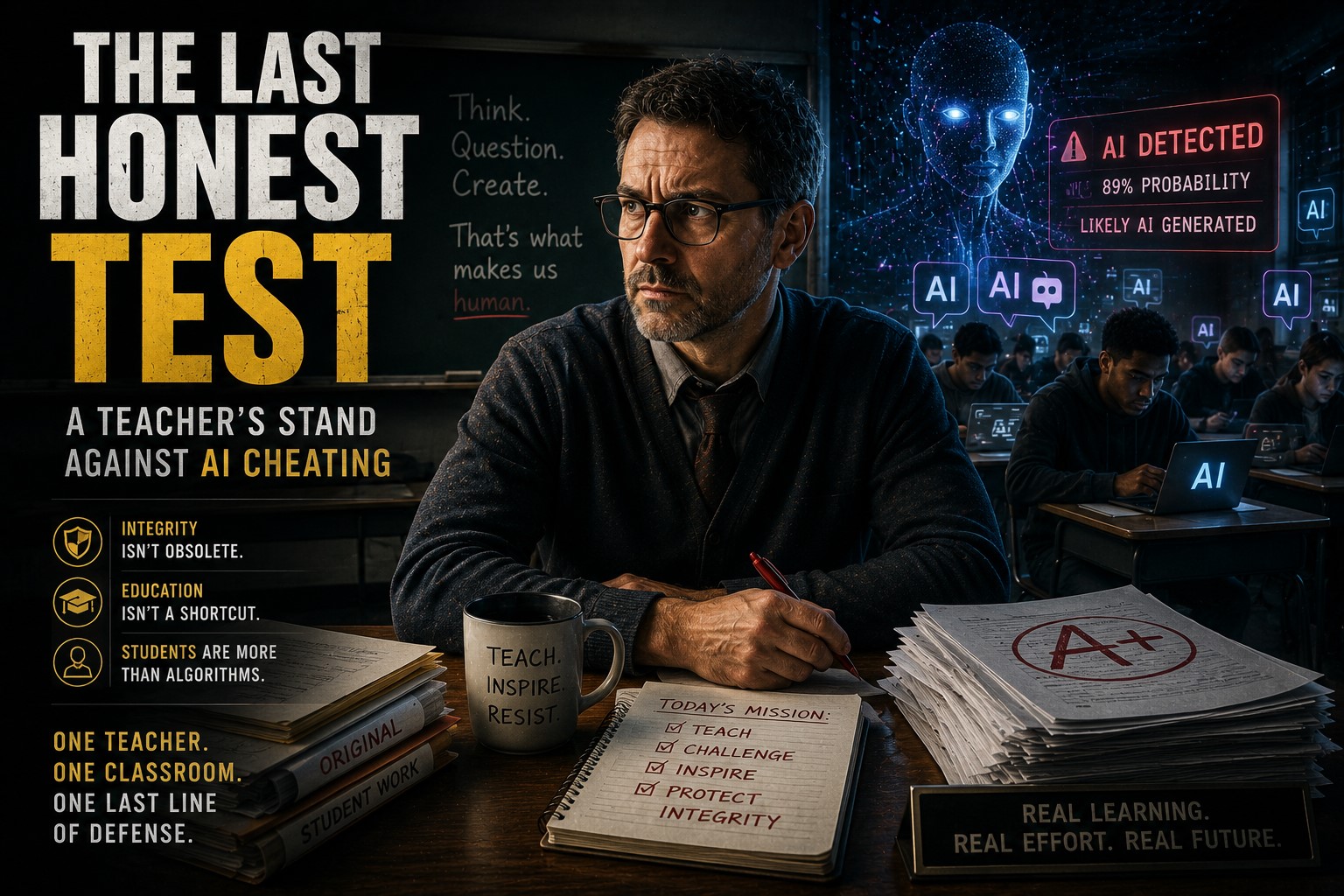
Professor David Harrison sat at his desk at 11:47 PM on a Tuesday night, staring at twenty-eight nearly identical essays about the Industrial Revolution. Not similar. Identical. Down to the same unusual phrasing, the same obscure historical references, and—most damning of all—the same completely fabricated quote attributed to a textile worker who never existed.
He rubbed his eyes and reached for his coffee mug, only to find it empty. How long had he been sitting here? The fluorescent lights in his small office at Riverside High School hummed overhead, the only sound in the empty building besides the occasional click of the radiator.
Twenty-three years. That’s how long David had been teaching history. Twenty-three years of trying to make the past come alive for teenagers who were more interested in their phones than the French Revolution. Twenty-three years of grading papers, attending faculty meetings, and believing—truly believing—that education mattered.
And now this.
He opened his laptop and typed the first sentence of Emma Chen’s essay into Google. Three seconds later, he had his answer. The text was from ChatGPT, word for word. He tried Michael Rodriguez’s paper. Same thing. Sarah Thompson’s. Identical.
Out of twenty-eight students, only three had written their own essays. Three.
David felt something crack inside him. Not anger—he’d moved past anger weeks ago. This was deeper. This was exhaustion. This was the slow, creeping realization that maybe he was fighting a battle he couldn’t win.
His phone buzzed. A text from his wife, Linda:
“Coming home soon? It’s almost midnight.”
He typed back: “Soon. Just finishing up.”
But he didn’t close his laptop. Instead, he opened a blank document and started typing. Not a strongly worded email to his students. Not a report to the principal. Something else entirely.
Something that would change everything.
Chapter Two: The History Teacher Who Hated History Class

David Harrison hadn’t always been tired.
Twenty-three years ago, fresh out of graduate school with a Master’s degree in American History and eyes full of naive optimism, he’d walked into his first classroom ready to change the world. He’d imagined inspiring discussions about civil rights, passionate debates about historical interpretation, students having genuine epiphanies about how the past shaped their present.
Reality hit hard and fast.
His first year teaching, a student had copied an entire essay from Wikipedia and didn’t even bother to remove the hyperlinks. Another had turned in a paper clearly written by a parent—complete with references to events that happened before the student was born, written in first person.
But David adapted. He learned to check for plagiarism. He designed assignments that were harder to fake. He built relationships with students, hoping that connection would inspire integrity.
For years, it worked. Sure, there were always a few students who tried to cheat. But most of them engaged. Most of them learned. Most of them walked out of his classroom knowing more about the world than when they walked in.
Then, in late 2022, everything changed.
ChatGPT launched to the public in November. By January, David noticed something odd. His usually struggling students were suddenly turning in eloquent, well-structured essays. His advanced students were producing college-level analysis.
At first, he was thrilled. Had his teaching finally broken through? Had something clicked?
Then he started reading more carefully.
The essays were good—sometimes too good. The voice was wrong. The phrasing was too formal. And they all had a similar… flavor. Like they’d been cooked in the same kitchen.
He ran a few through plagiarism checkers. Nothing. These weren’t copied from existing sources. They were original text.
Original text written by artificial intelligence.
David brought it up in the teachers’ lounge one afternoon in February. He was grading papers while his colleague, Patricia Williams—an English teacher with thirty years of experience—was doing the same.
“I think my students are using AI to write their essays,” he said, not looking up from the paper he was reading.
Patricia snorted. “You think? David, they’re all using it. Every single one of my classes. I can spot it now—it has this weird, overly formal tone. Like a very polite robot trying to sound human.”
“What are you doing about it?”
She shrugged. “What can I do? The plagiarism checkers don’t catch it. The principal says we need ‘definitive proof’ before we can accuse anyone. And honestly? I’m too tired to fight this battle. I’ve got three more years until retirement. I’m just trying to survive.”
David felt a chill run down his spine. Is that what he was doing? Just surviving?
“There has to be a way to—”
“There isn’t,” Patricia interrupted, her voice gentle but firm. “David, I’ve seen a lot of changes in thirty years. Calculators. Internet. Smartphones. Every time, we thought it would ruin education. Every time, we adapted. But this?” She gestured at her laptop. “This is different. The machine writes better than most of our students. Hell, it writes better than I do. How do you fight that?”
David didn’t have an answer.
That conversation haunted him for weeks. Was Patricia right? Should he just accept this new reality? Give up on teaching writing altogether and focus on… what? Multiple choice tests?
The thought made him physically ill.
By October, things had gotten worse. Students weren’t even trying to hide it anymore. They’d turn in essays and, when he called them to discuss the content, couldn’t answer basic questions about their own arguments.
“I don’t remember exactly,” became the standard response. “I wrote it last week.”
The administration wasn’t helping. At a faculty meeting in September, Principal Morrison had addressed the “AI situation.”
“We’re aware that some students may be using artificial intelligence tools to assist with their work,” he’d said, reading from prepared notes like he was discussing a minor scheduling conflict. “We encourage teachers to design assignments that minimize the opportunity for such shortcuts. However, we must also acknowledge that AI is a tool that exists in the real world, and perhaps we should be teaching students how to use it responsibly rather than pretending it doesn’t exist.”
David had raised his hand. “So we’re just… accepting this? We’re okay with students not learning to write?”
Morrison had smiled that patient, condescending smile administrators perfect over years of dealing with “difficult” teachers. “David, we’re evolving our understanding of what ‘learning’ means in the 21st century. Perhaps the skill isn’t writing the essay—it’s knowing what question to ask the AI.”
That’s when David had stopped going to faculty meetings.
And now, sitting in his office at midnight, looking at twenty-eight identical essays about the Industrial Revolution, he realized he’d reached a decision point.
He could do what Patricia was doing. Survive. Coast. Count down to retirement.
Or he could do something crazy.
David started typing.
Chapter Three: The Experiment
The next morning, David walked into his first period American History class with dark circles under his eyes but a strange energy in his step.
His students noticed immediately. They were trained to spot when teachers were in a mood—it usually meant a pop quiz or a lecture about “taking education seriously.”
But David didn’t hand out a quiz. He didn’t lecture. Instead, he pulled up a chair, sat down in front of his desk instead of behind it, and looked at his students in a way he hadn’t in months. Really looked at them.
Emma Chen was in the front row, her laptop already open, probably to whatever app she was currently obsessed with. Michael Rodriguez sat in the back, hoodie up, looking like he wished he was anywhere else. Sarah Thompson was doodling in her notebook. Tyler Kim was actually paying attention, one of the three students who’d written his own essay.
Twenty-eight kids. Each with their own story, their own struggles, their own dreams. When had he stopped seeing them as individuals and started seeing them as just another stack of papers to grade?
“We need to talk,” David said quietly.
The room went silent. This wasn’t his usual teacher voice—loud, authoritative, commanding attention. This was different. Personal.
“I graded your Industrial Revolution essays last night,” he continued. “And I have to be honest with you. I know that most of you didn’t write them yourselves.”
Uncomfortable shifting. A few students suddenly found their desks very interesting.
“I’m not going to lecture you about integrity. I’m not going to report you. I’m not even going to make you rewrite them.” He paused. “Instead, I’m going to tell you a story. And then I’m going to make you an offer.”
Now he had their attention.
“When I was your age—junior year of high school—I was failing English. Not because I was dumb. But because I hated writing. It felt pointless. Why did it matter if I could write a five-paragraph essay about symbolism in ‘The Great Gatsby’? Who cared?”
A few students nodded. They got that.
“My English teacher, Mr. Patterson, pulled me aside one day. He said, ‘David, I don’t care if you ever write another essay about a book you don’t care about. But I need you to write one essay about something that matters to you. Just one. And if you do that, I’ll pass you for the semester.'”
“That’s it?” Emma asked, breaking the silence. “One essay?”
“One honest essay,” David corrected. “Written by me, about something I actually cared about. No BS. No trying to sound smart. Just… real.”
“What did you write about?” Tyler asked.
David smiled, remembering. “My grandfather. He was a World War II veteran, and he’d just been diagnosed with Alzheimer’s. I was terrified I’d lose all his stories before I could learn them. So I wrote about that. About the fear of losing history. About how personal stories matter more than textbook facts.”
“Did he like it? Your teacher?”
“He cried,” David said softly. “Said it was the best thing any student had ever written for him. Not because it was technically perfect—it wasn’t. But because it was real. Because I cared.”
The room was completely quiet now. Even Michael had pushed his hoodie back.
“Here’s my offer,” David said, standing up. “I’m throwing out your Industrial Revolution essays. All of them. They’re garbage—whether you wrote them or ChatGPT did. Instead, I want you to write something that matters. Something real. Something that scares you a little because it’s actually honest.”
“Like what?” Sarah asked.
“Whatever you want,” David said. “But here’s the catch. You can’t use AI. Not even a little bit. And I’ll know if you do. Not because I’ll run it through some detector—those don’t work anyway. But because I’m going to sit down with each of you, one-on-one, and you’re going to talk to me about what you wrote. And if you can’t defend it, explain it, expand on it? Then we’ll both know the truth.”
“And if we don’t want to do it?” Michael asked, not hostile—genuinely curious.
“Then you fail my class,” David said simply. “Not because you’re a bad student. But because you chose not to engage. And I can’t teach someone who won’t engage.”
“That seems harsh,” Emma said.
“You know what’s harsh?” David walked over to his desk and picked up the stack of essays. “Spending four years in high school and never learning to express your own thoughts. Graduating and realizing you can use a tool but you can’t think for yourself. That’s harsh. That’s a failure—my failure as a teacher.”
He dropped the essays in the recycling bin.
“I don’t care about the Industrial Revolution. I care about you learning to think. To question. To argue. To express ideas that are yours, not some algorithm’s prediction of what sounds smart.”
“When’s it due?” Tyler asked.
“Three weeks. And here’s the other thing—you can write about literally anything. Your family. Your fears. Your dreams. A video game you love. A person who changed your life. A time you failed. A time you succeeded. Anything. The only requirement is that it matters to you.”
“How long does it have to be?” someone asked.
David almost laughed. Always the first question.
“As long as it needs to be. Could be one page. Could be ten. I don’t care about word count. I care about honesty.”
The bell rang. Students started packing up, but slower than usual. Thoughtful.
As they filed out, Emma stopped at his desk.
“Mr. Harrison?”
“Yeah?”
“Why now? Why not at the beginning of the year?”
David considered the question. “Because I gave up, Emma. I stopped believing you wanted to learn. And that was wrong of me. I’m sorry.”
She nodded slowly. “For what it’s worth? I know the essays were fake. We all did. It felt… bad. Like we were cheating ourselves, not just you.”
“So why did you do it?”
“Because we could,” she said simply. “Because it was easy. Because we’re tired and stressed and have six other classes and college applications and part-time jobs and… it’s just easier to let the machine do it.”
“I get that,” David said. “I really do. But easy isn’t always right.”
“I know,” Emma said. “I’ll write something real. I promise.”
After she left, David sat alone in his classroom for a long moment. He’d just committed to reading twenty-eight deeply personal essays and having twenty-eight individual conferences with students.
He’d just made his job ten times harder.
But for the first time in months, he felt like he was actually teaching.
Chapter Four: The Resistance

By lunchtime, word had spread. David’s “weird assignment” was the talk of the junior class.
He heard about it when he walked into the teachers’ lounge and Patricia gave him a look.
“Really, David? You’re making them write personal essays?”
“News travels fast.”
“Emma Chen is in my English class too. She told me all about your ‘experiment.'” Patricia poured herself coffee. “You know this is going to blow up in your face, right?”
“Maybe.”
“Parents are going to complain. Students are going to push back. Morrison’s going to call you into his office.”
“Probably.”
Patricia studied him for a long moment. “You’re serious about this.”
“I am.”
“Why?”
David sat down, suddenly feeling the weight of his decision. “Because I’m tired of pretending to teach and they’re tired of pretending to learn. Something has to change.”
“So you’re going rogue?”
“I’m going honest.”
Patricia was quiet for a moment. Then: “You know what? I’m in.”
“What?”
“I’m doing the same thing. Personal essays. Real writing. No AI. If you’re going down, I’m going down with you.” She raised her coffee mug. “To fighting losing battles.”
David clinked his mug against hers. “To teaching.”
But Patricia was right about the pushback.
By the end of the day, David had received three emails from concerned parents.
The first was from Emma’s mother:
“Mr. Harrison, Emma mentioned your new assignment. While I appreciate your intentions, I’m concerned about the ‘personal’ nature of the topic. Emma is a very private person, and I don’t think it’s appropriate to force students to share intimate details of their lives for a grade. Please reconsider this assignment.”
The second was from Michael’s father:
“My son informed me that you’re requiring handwritten essays without the use of any digital tools or resources. In the 21st century, this seems archaic and punitive. Students should be learning to leverage available technology, not avoid it. I’ll be contacting Principal Morrison about this.”
The third was the most painful. It was from Tyler Kim’s mom, one of the three students who’d actually written his own original essay:
“Mr. Harrison, I just wanted to say thank you. Tyler came home today actually excited about a school assignment for the first time in months. He said you believe in them. As a parent, that means everything. Whatever you’re doing, please keep doing it.”
David read that email three times. Then he forwarded it to Patricia with the subject line: “Why we do this.”
The next morning, as expected, he got a summons to Principal Morrison’s office.
Chapter Five: The Meeting

Principal Morrison’s office was exactly what you’d expect: diplomas on the wall, motivational posters about leadership, a desk organized with military precision. Morrison himself was mid-fifties, graying hair, expensive suit—more businessman than educator.
“David, come in. Sit down.” Morrison gestured to the chair across from his desk. His tone was friendly, but David had been teaching long enough to recognize the administrative version of “we need to talk.”
David sat.
“I’ve received some concerns from parents about a new assignment in your American History class.”
“The personal essay assignment.”
“Yes. Several parents feel it’s inappropriate. One threatened to contact the school board.” Morrison leaned back in his chair. “David, you’re a good teacher. One of our best. But you can’t just… go off-script like this. We have curriculum standards. Learning objectives. You can’t throw that out because you’re frustrated with AI.”
“I’m not throwing it out. I’m trying to actually achieve the learning objectives for once.”
“By making students write about their personal lives?”
“By making them write, period. Real writing. Their own thoughts. Not AI-generated nonsense that teaches them nothing.”
Morrison sighed. “David, I understand your frustration. We’re all dealing with the AI issue. But the reality is—”
“The reality is we’re failing them,” David interrupted. “We’re letting them graduate without learning to think critically, write clearly, or express original ideas. We’re giving them A’s for work they didn’t do because it’s easier than fighting. And we’re telling ourselves that’s okay because ‘technology is changing education.'”
“Watch your tone—”
“No.” David surprised himself with his firmness. “I’ve watched my tone for twenty-three years. I’ve been a good soldier. I’ve followed the rules. And you know what? I’m watching kids graduate who can’t write a paragraph without a computer doing it for them. That’s not education. That’s surrender.”
Morrison was quiet for a long moment. When he spoke again, his voice was different—less administrator, more human.
“You’re not wrong,” he said quietly. “About any of it. I’ve been in education for thirty-two years, David. I became a principal because I thought I could make a difference on a larger scale. And you know what I spend my time doing? Dealing with parent complaints. Managing budgets. Sitting in district meetings about standardized test scores. I can’t remember the last time I actually taught something.”
He stood up and walked to his window, looking out at the parking lot.
“Every teacher in this building is drowning. Too many students. Not enough resources. Parents who treat us like customer service representatives. And now AI that can do the students’ homework better than they can. I don’t have an answer for that, David. I wish I did.”
“So what are you saying? I should cancel the assignment?”
Morrison turned around. “I’m saying… be smart about this. Document everything. Make the assignment optional for students who are uncomfortable with the personal element—let them write about a historical figure or event if they prefer. Cover your ass administratively. But…” He paused. “But don’t stop trying. We need teachers who still care. God knows we don’t have enough of them.”
David felt something shift. “You’re not shutting me down?”
“I’m telling you to be careful. There’s a difference.” Morrison walked back to his desk. “One more complaint from a parent, and I’ll have to intervene. The school board doesn’t care about educational philosophy—they care about liability. Make this work, or I can’t protect you.”
“I understand.”
“And David? For what it’s worth? I hope it works. I really do.”
David left the office with a strange feeling. Not quite victory. Not quite defeat. Something in between.
He had three weeks to prove that this experiment could work. Three weeks to show that students could still learn to think for themselves.
Three weeks to save his own faith in teaching.
Chapter Six: The First Essay
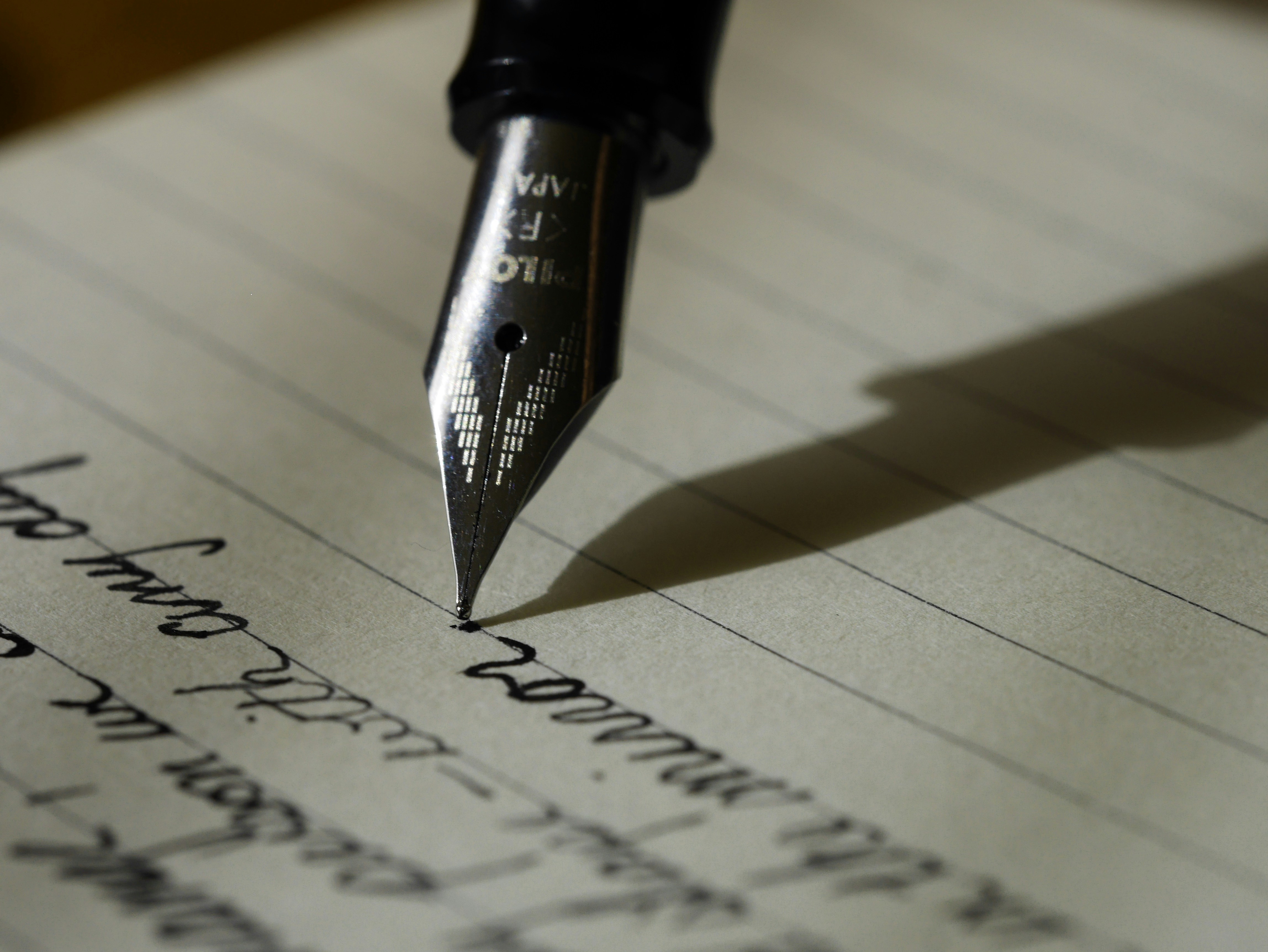
The essays started coming in during the second week.
The first one David received was from Tyler Kim—hand-delivered before class, as if Tyler was afraid to wait until the deadline.
“You can read it now if you want,” Tyler said nervously. “I mean, you don’t have to. But… I worked really hard on it.”
David took the stapled pages. “What’s it about?”
“My brother. He… he died two years ago. Car accident. I’ve never really talked about it with anyone.”
David looked up at Tyler, really seeing him for the first time. This quiet kid in the back of the class who always did his work but never said much. He was carrying this?
“Tyler, you didn’t have to write about something that painful—”
“I wanted to,” Tyler said quickly. “You said to write about something that matters. He matters. He’ll always matter.”
After Tyler left, David sat down and read the essay. It was rough—grammatically imperfect, structurally awkward in places. But it was also the most honest, heartbreaking thing he’d read in years.
Tyler wrote about the last conversation he’d had with his brother. About the guilt of their last words being an argument about borrowing a video game. About how he’d give anything to tell his brother he loved him one more time.
About how he’d stopped raising his hand in class because his brother had always been the smart one, and without him, Tyler didn’t know who he was supposed to be.
David sat in his empty classroom and cried.
Not because the essay was sad—though it was. But because this was what he’d been missing. This was real. This was a human being sharing something true.
This was why he’d become a teacher.
The next essay came from Emma Chen. She’d written about being the child of immigrants, about the pressure to be perfect, about the paralyzing fear that if she wasn’t the best at everything, she’d be letting down her parents who’d sacrificed everything for her.
About how using AI to write her essays felt like both relief and failure—relief from the pressure, but failure because she knew she wasn’t really learning anything.
“I use ChatGPT because I’m scared,” she wrote. “Not scared of bad grades. Scared of being mediocre. Scared of not being special. And somewhere along the way, I forgot that learning is supposed to make you better, not just make you look better.”
David called her in for the required conference.
“This is brave,” he told her. “Really brave.”
“It’s terrifying,” Emma admitted. “I almost didn’t turn it in. I rewrote it four times because I kept thinking it wasn’t good enough.”
“It’s honest. That makes it good enough.”
“But the grammar is—”
“Emma, I can teach you grammar. I can teach you structure. But I can’t teach you to have something worth saying. You already have that. You just have to trust it.”
She nodded, blinking back tears. “Can I tell you something?”
“Of course.”
“I haven’t written anything real in… I don’t know how long. Everything is just about getting the grade. Hitting the rubric points. Making it sound smart. But I don’t feel smart. I feel empty.”
“You’re not empty, Emma. You’re exhausted. There’s a difference.”
Over the next week, more essays arrived. Sarah Thompson wrote about her eating disorder and how social media made it worse. Michael Rodriguez wrote about being the first in his family to potentially go to college and the weight of those expectations.
Jessica Park wrote about losing her best friend to suicide and how she still texted her sometimes, just to feel less alone.
Brandon Williams wrote about being dyslexic and how much he hated school because reading took him three times longer than everyone else, so he’d started using AI just to keep up.
Each essay was imperfect. Each one had grammatical errors, structural issues, places where the writing could be stronger.
And each one was absolutely beautiful.
These weren’t polished, AI-generated essays that said nothing. These were raw, honest, messy pieces of writing from real human beings trying to make sense of their lives.
This was what teaching was supposed to be.
Chapter Seven: The Holdout

With one week left until the deadline, David had received essays from twenty-four of his twenty-eight students.
Four were still outstanding.
Three of them he wasn’t worried about—they’d told him they were working on it, just needed more time. But the fourth was Marcus Peterson.
Marcus was the kid every teacher worried about. Not because he was a troublemaker—he wasn’t. But because he’d perfected the art of being invisible. He sat in the back, never caused problems, turned in just enough work to pass, and gave the impression of someone who’d checked out of school entirely.
David had tried reaching out before. Marcus was polite but distant. “I’m fine, Mr. Harrison. Just trying to get through, you know?”
After class on Thursday, David asked Marcus to stay back.
“Marcus, the deadline’s in a week. Have you started the essay?”
Marcus shrugged. “Not really.”
“Is there a problem? If you’re uncomfortable with the personal element—”
“It’s not that.”
“Then what is it?”
Marcus looked at him for a long moment. Then: “What’s the point?”
“The point of the assignment?”
“The point of any of this. School. Essays. Learning. What’s the point when AI can do it all better than me?”
David pulled up a chair and sat down. “That’s a fair question.”
“Is it? Because everyone keeps saying ‘AI is a tool,’ like that makes it better. But… I’m not good at anything, Mr. Harrison. Not sports. Not art. Not music. The one thing I was kind of okay at was writing. And now a computer can do it better. So what do I have?”
The raw honesty in Marcus’s voice hit David like a punch to the gut.
“Marcus, can I tell you something? Not as your teacher. Just… as a person.”
“Sure.”
“I’ve been teaching for twenty-three years. I’ve read thousands of essays. And you know what I’ve learned? The computer can write prettier sentences than you. It can structure arguments better. It can cite sources perfectly. But it can’t do the one thing that actually matters.”
“What’s that?”
“It can’t be human. It can’t feel. It can’t struggle. It can’t learn from failure. It can’t grow.”
“So?”
“So that’s your advantage. Not that you can outwrite a computer. But that you can be something a computer will never be—a real person with real experiences and real thoughts. That’s not a weakness. That’s literally the only thing that matters.”
Marcus was quiet for a long time. “I don’t know what to write about.”
“Write about that. Write about feeling like you don’t have a point. Write about being scared that computers are making you obsolete. Write about… anything that’s real for you.”
“And if it’s bad?”
“Then it’s bad. But it’ll be yours. And that makes it valuable.”
Marcus nodded slowly. “I’ll try.”
“That’s all I’m asking.”
The deadline was Monday. On Sunday night at 11:47 PM, David received an email from Marcus. No subject line. Just an attachment.
David opened it.
The essay was titled: “Why I Almost Didn’t Write This.”
It was three pages long. Hand-typed, clearly—there were typos and formatting issues. But as David read, he felt that familiar tightness in his chest that meant a student had broken through.
Marcus wrote about depression. About feeling worthless. About how AI had somehow made it worse because now even the one thing he was moderately good at—writing—felt pointless.
About how he’d almost not written the essay. How he’d sat in front of a blank document for three hours, typing and deleting, typing and deleting.
About how Mr. Harrison’s stupid assignment had made him realize something: maybe the point wasn’t to be better than a computer. Maybe the point was just to be honest. To exist. To matter.
The essay ended with:
“I don’t know if this is good. I don’t know if it matters. But I wrote it. Me. Not a computer. Not some algorithm. Me. And maybe that’s enough.”
David sat in his home office, reading Marcus’s essay for the third time. His wife Linda came in.
“It’s almost midnight. Coming to bed?”
“In a minute.” He looked up at her. “Linda, I think… I think this actually worked.”
“The assignment?”
“Yeah. These kids… they actually learned something. Not about the Industrial Revolution. About themselves. About being human.”
Linda smiled. “So you’re not quitting teaching?”
“What? When did I say—”
“You didn’t say it. But I could see it. For months, you’ve been coming home defeated. Like you’d given up.”
David thought about that. “I had. I didn’t realize it, but I had.”
“And now?”
“Now… now I remember why I do this.”
Chapter Eight: The Reckoning

Monday morning, David walked into his classroom with all twenty-eight essays graded and ready to return.
But he didn’t hand them back right away. Instead, he sat on the edge of his desk and looked at his students.
“Before I return these, I want to say something. And I need you to really hear me.”
The room went quiet.
“Three weeks ago, I was ready to give up on teaching. Not just on you—on the whole profession. I felt like I was wasting my time trying to teach writing in a world where computers could write better than most humans.”
He could see students exchanging glances.
“But then you did something I didn’t expect. You were honest. You were vulnerable. You wrote things that scared you to share. And in doing that, you reminded me why teaching matters.”
He picked up the stack of essays.
“These aren’t perfect. Some of them have grammar errors. Some have structural issues. Some are rough and messy and would probably get flagged by any automated grading system as ‘needs improvement.'”
“But they’re also the best essays I’ve read in years. Not because they’re technically perfect. But because they’re real. Because they’re yours.”
Emma raised her hand. “What did we get? Grade-wise?”
David smiled. “Everyone who submitted an essay got an A.”
Surprised murmurs.
“Wait, everyone?” Michael asked. “Even if we made mistakes?”
“Everyone who did the actual assignment—who wrote something honest and defended it in our conference—earned an A. Because the assignment wasn’t about perfect grammar. It was about learning to express your own thoughts. And you all did that.”
“But what about the mistakes?” Sarah asked. “Don’t those matter?”
“Of course they matter. And we’re going to spend the next few weeks learning how to fix them. But first, I needed you to care about what you were writing. Because if you don’t care, all the perfect grammar in the world won’t make it good writing.”
He started passing back essays. Each one had extensive comments—not just corrections, but reactions, questions, connections.
When he got to Marcus, he handed back the essay and quietly said, “Can you stay after class?”
Marcus nodded, looking nervous.
After everyone left, Marcus approached David’s desk.
“Am I in trouble?”
“No. The opposite.” David pulled out a folder. “Marcus, I took the liberty of making a copy of your essay. With your permission, I’d like to submit it to a student writing competition. I think… I think it’s special.”
Marcus stared at him. “My essay? But it’s full of mistakes.”
“It’s full of truth. The mistakes we can fix. The truth—that’s rare. That’s valuable.”
“I don’t… I don’t know what to say.”
“You don’t have to say anything. Just… keep writing. Keep being honest. The world needs that.”
Marcus left looking dazed. David sat alone in his classroom, feeling something he hadn’t felt in a long time.
Hope.
Chapter Nine: The Ripple Effect

Word spread.
By the end of the week, three other teachers had approached David about the assignment. Patricia wasn’t the only one tired of fake essays.
The English department adopted a modified version. The Science department created a “Why Science Matters to Me” essay requirement. Even the Math department—traditionally the most resistant to writing—started asking students to explain their problem-solving process in their own words.
Principal Morrison called David into his office again. This time, the tone was different.
“I’ve been getting calls from parents,” Morrison said.
David’s heart sank. “Complaints?”
“The opposite. Three parents called to thank me personally for ‘finally having teachers who care about real learning.’ One parent said her daughter actually enjoys school again.” Morrison leaned back in his chair. “What did you do?”
“I just… asked them to be honest.”
“Well, keep doing it. The superintendent wants to visit your class next month. She’s interested in piloting this approach district-wide.”
David couldn’t believe what he was hearing. “District-wide?”
“Don’t get too excited. It’s just a pilot program. But… yeah. You might have started something.”
That night, David got an email from Tyler Kim’s mother:
“Mr. Harrison, I don’t know what you did, but thank you. Tyler has been different since your class. He talks at dinner again. He laughs. He seems… lighter. His therapist says he’s made more progress in the last month than in the previous year. You gave him permission to be honest about his grief. That gift is invaluable. Thank you.”
David read that email three times, then forwarded it to Linda with the subject line: “This is why.”
But not everything was perfect. The district’s push for standardized testing conflicted with the personal essay approach. Some parents still complained about the “touchy-feely” nature of the assignments. And AI continued to evolve, getting better and harder to detect.
At a department meeting in December, Morrison addressed the challenge directly.
“We can’t stop AI. It’s here. It’s getting better. But what we CAN do is teach students that the value of education isn’t in the product—it’s in the process. It’s in learning to think, to question, to express ideas that matter.”
He looked at David. “Some teachers are fighting AI by trying to detect it and punish it. David’s approach is different. He’s making assignments where AI is useless because the value is in the authenticity, not the output. That’s the model we need.”
After the meeting, Patricia pulled David aside.
“You know you’ve made us all look bad, right?”
“What?”
“I’m kidding. Sort of.” She smiled. “But seriously—you’ve reminded us why we became teachers. That’s… that’s not a small thing.”
Chapter Ten: Six Months Later
It’s April now. David Harrison sits in his classroom after school, grading the latest round of essays from his American History students.
These aren’t personal essays—they’re analysis pieces about the Civil Rights Movement. But there’s something different about them. They’re not AI-generated. He can tell because they have voice. Personality. Individual thinking.
Sure, some students probably used AI to help with research or to check their grammar. But the ideas, the arguments, the connections—those are authentically theirs.
Because somewhere along the way, they learned that their thoughts mattered.
Emma Chen stopped by after school.
“Mr. Harrison? I just wanted to tell you something.”
“What’s up, Emma?”
“I got into Stanford. Early admission.”
“That’s amazing! Congratulations!”
“My essay… I wrote about your class. About learning to be honest. About how I’d been hiding behind perfection and AI and fear, and how your assignment forced me to actually think and feel and write like a real person.”
She paused. “The admissions officer told my guidance counselor that my essay was the most genuine one they’d read all year. So… thank you. For teaching me that being real is more important than being perfect.”
After Emma left, David got an email from Marcus Peterson:
“Mr. Harrison, I won the writing competition. I don’t know how. My essay is full of mistakes. But I guess that’s the point you were trying to teach us. The mistakes don’t matter as much as the truth. Anyway, thought you’d want to know. Thanks for not giving up on me. -Marcus”
David sat back in his chair and smiled.
The AI problem hadn’t gone away. Students still used ChatGPT. They still looked for shortcuts. Technology continued to evolve.
But something had changed. His students had learned that there are some things a computer can’t do. It can’t feel. It can’t struggle. It can’t grow. It can’t be human.
And being human—messy, imperfect, authentic—that’s the only thing that really matters.
His phone buzzed. A text from Linda:
“Coming home for dinner? I’m making your favorite.”
David packed up his bag and looked around his classroom one more time. Twenty-three years. Thousands of students. Countless papers graded.
And finally, finally, he felt like he was actually teaching.
He turned off the lights and headed home.
Epilogue: One Year Later
The following school year, Riverside High School launched the “Authentic Learning Initiative”—a district-wide program based on David’s original experiment.
Every department incorporated assignments that required genuine human thinking, feeling, and expression. AI wasn’t banned—students were taught to use it as a tool for research and editing, but never as a replacement for their own ideas.
Marcus Peterson’s essay was published in a national educational journal as an example of student voice. He went on to study creative writing in college, crediting Mr. Harrison’s class as the moment he discovered he had something worth saying.
Emma Chen thrived at Stanford, where she founded a student organization dedicated to promoting academic integrity in the age of AI. She still emails David occasionally with updates, always signing off with: “Thanks for teaching me to be real.”
Tyler Kim became a peer counselor at school, helping other students struggling with grief and loss. He credited the essay assignment with giving him permission to be honest about his pain.
As for David Harrison? He’s still teaching American History at Riverside High. Still grading papers late at night. Still fighting the good fight.
But now, when he sits down to read his students’ essays, he doesn’t see AI-generated text. He sees humans. Real, flawed, beautiful humans trying to make sense of the world.
And that makes all the difference.
The battle against AI cheating isn’t over. It probably never will be. Technology will keep evolving. Students will keep looking for shortcuts.
But David learned something important: You can’t fight technology with technology. You fight it with humanity. With connection. With caring enough to see students as people, not just names on a roster.
And when you do that—when you remind students that they matter, that their thoughts are valuable, that authenticity is worth more than perfection—something magical happens.
They start to believe it.
And once they believe it, no algorithm in the world can replace what they have to offer.
Because being human isn’t a bug.
It’s the feature.
Author’s Note
This story is fictional, but the struggle is real. Teachers everywhere are grappling with how to maintain academic integrity and genuine learning in an age where AI can complete most assignments better than students can.
The “solution” presented in this story—focusing on authentic, personal connection and honesty—isn’t perfect. It doesn’t work for every subject or every student. But it represents something important: the reminder that education is fundamentally about human development, not just information transfer.
To the teachers reading this: Thank you for not giving up. Thank you for fighting for authentic learning. Thank you for seeing your students as human beings, not just data points or test scores.
To the students: Your thoughts matter. Your voice matters. Don’t let any tool—AI or otherwise—convince you that you have nothing unique to offer. The world needs your authentic self, imperfections and all.
And to everyone: In a world increasingly mediated by technology, the most radical thing we can do is be genuinely, vulnerably, messily human.
– Sarah Mitchell, Educator and Writer
November 2025