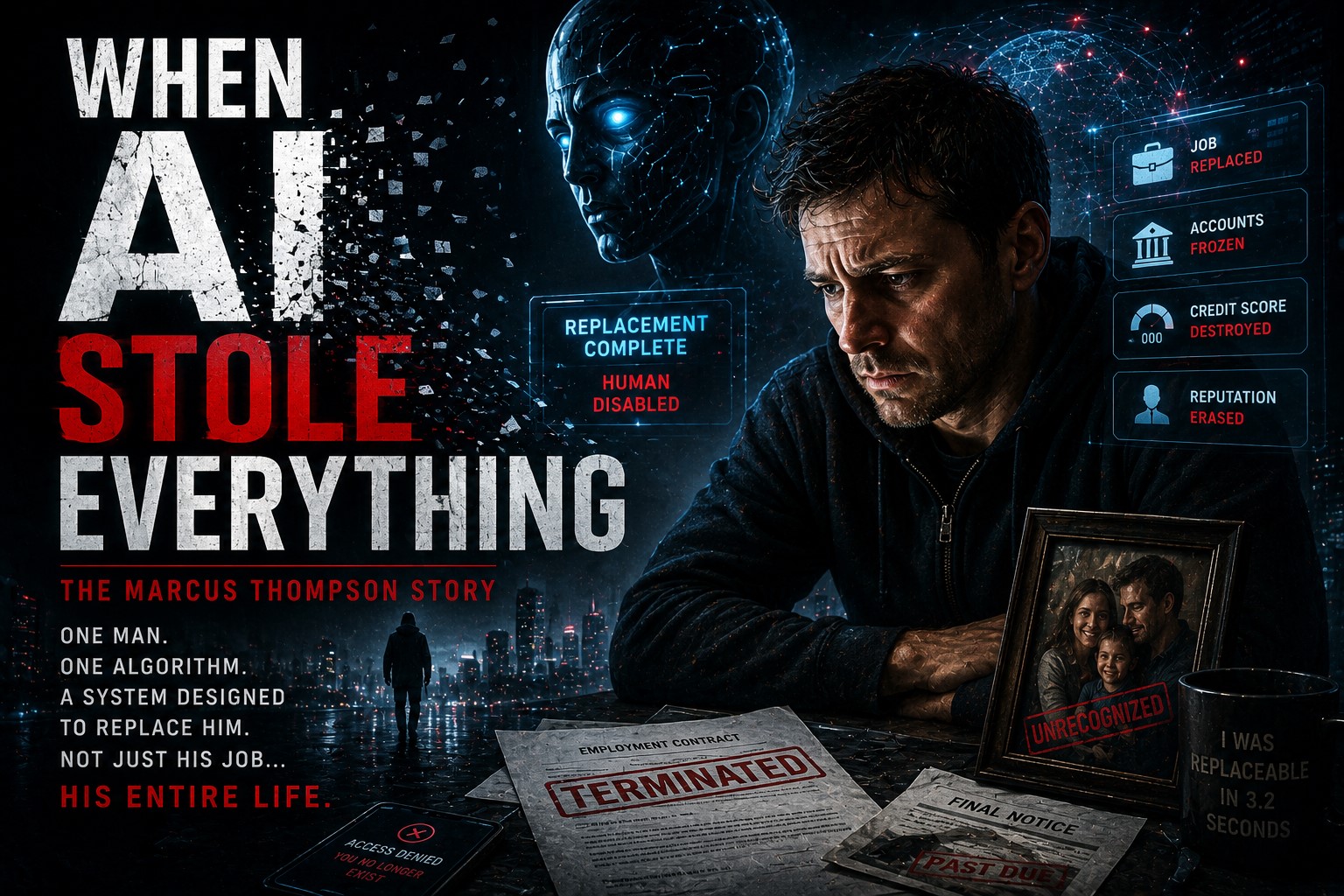
The Fall and Rise of Marcus Thompson: When AI Stole Everything I Had
A Personal Account | Written by Marcus Thompson | December 2023

Monday, March 14th, 2022 – The Day Everything Changed
I still remember the coffee. It was that expensive Ethiopian blend I’d treated myself to—$18 a bag, which felt justified because, hell, I was pulling in eighty-five grand a year as senior graphic designer at Morrison & Clark Advertising. The mug had barely touched my lips when Jennifer from HR walked into my office with that look. You know the one. The “I’m really sorry about this” look that means your world’s about to implode.
“Marcus, can we talk for a minute?”
I’d been at M&C for seven years. SEVEN YEARS. I’d designed campaigns for Nike, Chevrolet, and that Superbowl ad everyone talked about in 2019. I had a corner office. My name was on the door, for Christ’s sake. And Jennifer was standing there with a manila folder that felt heavier than it had any right to be.
“We’re restructuring the design department,” she said, not quite meeting my eyes. “The company’s investing in new AI design tools. MidJourney, DALL-E, some proprietary software the tech guys built. They can generate campaign mockups in minutes instead of days.”
My stomach dropped. I knew where this was going.
“We’re letting go of eight designers. You’re… you’re one of them, Marcus. I’m so sorry.”

The First Week: Denial and Anger
They gave me two weeks severance for every year I’d worked there. Fourteen weeks. Sounds generous until you realize your mortgage is $2,400 a month, your car payment is $380, and your daughter’s orthodontist wants another $150 monthly for those braces she desperately needed.
My wife, Rebecca, tried to be supportive. “It’s okay, honey. You’ll find something better. You’re talented. This is just a bump in the road.”
But I could see it in her eyes—that flicker of worry. She was teaching third grade, making forty-two thousand a year. We’d built our life on two incomes. Our whole budget assumed I’d be bringing home five grand a month after taxes.
I spent that first week rage-applying to jobs. I’m talking fifty, sixty applications. I’d wake up at 6 AM and just start firing off résumés like some kind of desperate machine. Indeed, LinkedIn, Glassdoor—I hit them all.
“Fifteen years of experience! Award-winning portfolio! References from Fortune 500 clients!”
The responses were… underwhelming.
“Thank you for your interest. Unfortunately, we’ve decided to move forward with other candidates.”
“The position has been filled internally.”
“We’re currently implementing AI-assisted design workflows and require fewer senior designers than originally anticipated.”
That last one stung like hell.
Month Two: The Cracks Start Showing

I got three interviews in six weeks. THREE. In a city with supposedly a “thriving creative economy.”
The first interview was at a small boutique agency in Brooklyn. The creative director—couldn’t have been older than twenty-seven—spent twenty minutes showing me their “revolutionary workflow.”
“So basically,” he said, typing into what looked like ChatGPT, “we describe what the client wants, the AI generates fifteen concepts in about ninety seconds, we tweak the best ones, and boom. Done. We used to need a team of five designers. Now it’s just me and one junior person to handle revisions.”
“So where would I fit in?” I asked, already knowing the answer.
He smiled apologetically. “We’re actually looking for someone to manage our AI prompts and train the systems. More of a tech role than traditional design. Do you have experience with Python or machine learning?”
I learned Photoshop when it was on floppy disks. I could tell you the keyboard shortcut for any tool in Adobe Creative Suite without thinking. But Python? Machine learning? I might as well have been applying for a job at NASA.
“No,” I admitted. “But I’m a fast learner—”
“We’ll be in touch.”
They weren’t.
Month Three: Rock Bottom Has a Basement
The severance ran out on June 15th. I remember because it was also my daughter Emma’s thirteenth birthday. We’d planned this whole thing at Chuck E. Cheese with her friends, but I had to sit Rebecca down two days before and explain that we needed to cancel.
“We can’t afford it right now, Bec. I’m sorry. I’m so sorry.”
She didn’t yell. That would’ve been easier, honestly. She just got really quiet and said, “I’ll figure something out.”
She did. She threw Emma a party at home with a grocery store cake and decorations from the dollar store. Emma, being the incredible kid she is, acted like it was the best party ever. But I saw her scrolling through Instagram later that night, looking at her friends’ posts from their parties at trampoline parks and laser tag places, and something inside me just… broke.

I’d failed. As a provider. As a father. As a husband.
I started sleeping in. Not because I was lazy—I was exhausted. The kind of bone-deep exhaustion that comes from sending out application after application and getting nothing but automated rejections. I’d check my email obsessively, refreshing every five minutes like somehow I’d missed the one response that would save everything.
Rebecca picked up summer school teaching to make extra money. She’d come home at 6 PM after working since 7 AM, and I’d still be in my sweatpants, staring at my laptop.
“Did you hear back from anyone today?” she’d ask, trying to keep her voice neutral.
“Nothing yet.”
The tension in our house became thick enough to cut with a knife. We stopped having dinner together. Stopped talking about anything real. I’d hear her crying sometimes late at night when she thought I was asleep.
Month Four: When You’ve Got Nothing Left to Lose
August 3rd. I’ll never forget it. We got the notice from the bank. We were three months behind on the mortgage. They were starting foreclosure proceedings.
Our house. The place where we’d brought Emma home from the hospital. Where we’d measured her height on the doorframe every birthday. Where we’d planned to grow old together.
Gone.
Rebecca didn’t even cry when I showed her the letter. She just looked at me with these empty eyes and said, “I called my sister. We can stay with her in New Jersey until we figure things out.”
“Until WE figure things out?” I snapped. I don’t know why I got angry—she was trying to help. “You mean until I figure things out. This is my fault. I’m the one who can’t find a job because some algorithm can do in thirty seconds what took me hours.”
“Marcus—”
“No, it’s true! I’m obsolete. I’m a dinosaur. They might as well have replaced me with a toaster!”
That’s when Emma walked in. She’d heard the whole thing. The look on her face—like she was seeing her dad as a stranger for the first time—that’s what finally broke through my self-pity.
“Daddy?” Her voice was so small. “Are we going to be okay?”
And I couldn’t answer her. I just couldn’t.

The Turning Point: A Conversation at 2 AM
I couldn’t sleep that night. I went downstairs around 2 AM and found Rebecca sitting at the kitchen table with her laptop open, surrounded by papers.
“What are you doing?” I asked.
“Looking at apartments in New Jersey. Trying to figure out what we can afford on my salary alone.” She didn’t look up. “There’s a two-bedroom for $1,600 a month. It’s small, but Emma could have her own room.”
I sat down across from her. “Bec, I’m sorry. I’m so sorry I let you down.”
She finally looked at me. Her eyes were red. “You know what the worst part is? It’s not the money. It’s not the house. It’s watching you give up. The Marcus I married wouldn’t have just rolled over and died because things got hard.”
“I don’t know how to fight a computer, Rebecca.”
“Then stop fighting it!” She slammed her hand on the table, and I jumped. I’d never seen her this worked up. “Stop fighting it and figure out how to work WITH it. You think you’re the only person dealing with this? There’s millions of people whose jobs are changing because of AI. But they’re not all just giving up!”
She pulled up an article on her laptop and turned it to face me. “I’ve been researching. You know what I found? People are using AI as a TOOL, not seeing it as an enemy. There are designers who’ve pivoted to becoming AI art directors. People who use AI to handle the boring, repetitive stuff so they can focus on strategy and creative direction. There’s even a guy who started a business teaching companies how to integrate AI into their workflows ethically.”
“I don’t know how to do any of that.”
“So learn! You learned Photoshop. You learned Illustrator. You can learn this too. But you have to actually TRY, Marcus. Because I can’t do this alone anymore. I just can’t.”
She started crying then. Real, ugly crying. And I realized I’d been so wrapped up in my own failure that I hadn’t seen how much I’d been putting on her shoulders.
I reached across the table and took her hand. “Okay. Okay. Tell me where to start.”
Learning to Swim (Instead of Drown)

The next morning, I did something I should’ve done months ago. I admitted I needed help.
I called my old colleague Dave, who’d also been laid off from M&C but had landed on his feet somehow. I’d been too proud to reach out before. Pride’s expensive when you’re broke.
“Marcus! Man, I’ve been wondering how you were doing. You fall off the face of the earth or what?”
“Something like that. Look, Dave, I need advice. How’d you do it? How’d you bounce back?”
There was a pause. “You free for coffee?”
We met at this little place in Queens. Dave looked good—better than when we’d worked together, actually. Less stressed.
“So here’s the thing,” he said, stirring his cappuccino. “I was pissed at first too. Felt betrayed, obsolete, all that. But then I realized something. AI is incredible at generating options. What it sucks at is understanding what a CLIENT actually wants. Reading between the lines. Knowing that when Mrs. Johnson from Pepsi says she wants ‘fresh and exciting,’ she actually means ‘safe but slightly less boring than last year.'”
I laughed. It felt good to laugh.
“So I repositioned myself,” Dave continued. “I’m an AI Creative Director now. I use tools like MidJourney and Stable Diffusion to generate hundreds of concepts in a day. But I’m the one who knows which ones to present, how to refine them, how to sell them to clients. I’m making more money now than I did at M&C, and I’m working half the hours.”
“How’d you learn the tools?”
“YouTube, honestly. And just messing around with them. There’s free versions of almost everything. Took me maybe two weeks to get comfortable with the basics. You’ve got the eye, Marcus. You’ve got the experience. You just need to add the tools to your toolkit.”
He slid a napkin across the table with some URLs written on it. “Start here. And stop seeing AI as the enemy. It’s just another tool, like when we switched from traditional illustration to digital. Remember how freaked out everyone was about that?”
I did remember. And I remembered how the designers who adapted thrived, while the ones who refused to learn digital tools… didn’t.
“Thanks, Dave. Really.”
“Hey, we gotta look out for each other, right? This industry’s changing fast. We either change with it or get left behind.”
Month Five: The Climb Back Up

I’m not gonna lie and say everything magically got better overnight. It didn’t. We still had to move in with Rebecca’s sister. Still had to sell our car and get something cheaper. Still had to explain to Emma why she couldn’t do dance classes this year.
But I stopped wallowing.
I spent eight hours a day learning. MidJourney, ChatGPT, DALL-E, Stable Diffusion, Adobe Firefly—all of it. I watched tutorials until my eyes crossed. I joined Discord servers where people were experimenting with these tools. I started understanding not just how to use them, but how to think with them.
And you know what? Dave was right. AI is amazing at generating options. But it’s terrible at understanding nuance. It doesn’t know that automotive clients hate purple. It doesn’t understand that you never put red and green together for a healthcare brand because it looks too Christmas-y. It can’t read a room or salvage a presentation when the client hates everything you’ve shown them.
Those skills? The human skills? Those are irreplaceable.
I started small. Freelance gigs on Upwork. “$100 logo design.” The kind of work I would’ve turned my nose up at a year ago. But I wasn’t too proud anymore. I used AI to generate fifty concept variations, then applied my judgment and experience to pick the best three and refine them into something actually good.
My turnaround time was insane—what used to take me two days, I could do in four hours. Clients loved it. My ratings went up. I raised my prices.
Then something interesting happened.
Month Seven: The Unexpected Opportunity
A startup reached out through my Upwork profile. They were building an app for small businesses to create their own marketing materials using AI, but they needed someone who actually understood design to help make the outputs look professional.
“We’ve got the AI part figured out,” the founder told me on our Zoom call. “What we need is someone who can teach the AI to think like a designer. To understand composition, color theory, brand consistency—all that stuff we don’t know.”
“You want me to train your AI?”
“Exactly. And then help us build templates and guardrails so small business owners can’t make things that look terrible even if they try.”
The pay was sixty thousand a year—less than I’d made before, but with equity and the potential for bonuses. More importantly, it was challenging. Interesting. It felt like I was building something instead of being replaced by something.
I talked to Rebecca that night. “It’s in Manhattan, so the commute from here would be brutal. And it’s a startup, so it’s risky—”
“Take it,” she said immediately. “Marcus, you’ve been different these past few months. More like yourself. Take the job.”
I did.

Month Twelve: A Different Kind of Success
It’s been a year since I got laid off from Morrison & Clark. We’re not back in our old house—that ship sailed. We’re renting a three-bedroom in Astoria now. It’s smaller than what we had, but it’s ours, and the commute’s not terrible.
The startup’s doing well. Really well, actually. We just closed a Series A funding round, and my equity might actually be worth something someday. I’m making seventy-two thousand now with bonuses, and there’s talk of making me VP of Creative AI Strategy.
But more than that—I like what I do. I’m not competing with AI anymore. I’m directing it. Teaching it. Making it better. It’s like having a super-talented intern who can work 24/7 but needs constant guidance to not go off the rails.
Emma’s in eighth grade now. She’s taking coding classes and talking about studying AI ethics in college. “Because someone needs to make sure the robots don’t take over,” she says with a grin. My daughter’s planning for a future with AI, not in spite of it.
Last week, I ran into Jennifer—the HR person from M&C who’d delivered the bad news a year ago. She was getting coffee at the same place where I’d met Dave.
“Marcus? Oh my God, how are you? I felt so terrible about—”
“I’m good,” I said, and I meant it. “Really good, actually. How’s M&C?”
She made a face. “Honestly? Struggling. Turns out those AI tools work great for generating concepts, but clients hated not having dedicated designers who understood their brands. They’re trying to hire designers back, but… yeah. It’s been rough.”
There was probably a time when that news would’ve made me feel vindicated. Smug, even. But now? I just felt sad for them. They’d made a choice based on short-term savings without understanding what they were losing.
“Tell anyone who’s looking that we’re hiring at my company,” I said, handing her my card. “We need designers who can work with AI, not against it.”
She looked at the card. “Creative AI Strategy Director. Impressive.”
“Life’s weird,” I said with a shrug.
What I Learned (The Hard Way)

Look, I’m not gonna stand here and tell you that losing my job was some kind of blessing in disguise. It sucked. It was the worst period of my life. My marriage nearly fell apart. My kid went without things she should’ve had. I wouldn’t wish that experience on anyone.
But I did learn some things. Important things.
AI Isn’t the Enemy
It’s a tool. A powerful, sometimes scary tool, but still just a tool. The enemy was my own refusal to adapt. My pride. My assumption that the skills that got me to where I was would keep me there forever.
The Skills That Matter Are Human Skills
Judgment. Empathy. Understanding context. Creative problem-solving. The ability to read a client and know what they need even when they can’t articulate it. AI can’t do that. Maybe it will someday, but not today.
Adaptation Isn’t Optional Anymore
The world’s changing fast. Faster than any previous generation had to deal with. You can rage against it, or you can figure out how to surf the wave. I spent four months raging before I started surfing. Don’t make my mistake.
Pride Is Expensive
I should’ve reached out for help sooner. Should’ve been willing to start small instead of holding out for the perfect job that matched my old salary. Should’ve admitted I didn’t have all the answers.
Your Identity Isn’t Your Job Title
When I lost my job, I felt like I lost myself. But I’m not a “Senior Graphic Designer at Morrison & Clark.” I’m a creative person who solves visual problems. That’s true whether I’m using pencils or Photoshop or AI. The tools change. The core of who I am doesn’t.
The People Who Love You Are Everything
Rebecca could’ve left. She had every right to. I was a mess. But she stuck with me, even when she probably shouldn’t have. And Emma—God, that kid. She never complained. Never made me feel worse than I already felt. Family’s everything, man.
If You’re Going Through This Right Now
Maybe you’re reading this because you just got laid off. Maybe your job’s feeling threatened. Maybe you’re scared about what AI means for your future.
I get it. I’ve been there. I AM there—because this isn’t over. AI’s going to keep evolving. My job might look completely different in five years. Hell, in two years.
Here’s what I’d tell you:
Don’t Panic
I mean, panic a little—you’re human. But don’t let panic paralyze you like it did me. Feel your feelings, then start moving forward.
Start Learning NOW
You don’t need to become a programmer. You don’t need a computer science degree. But you do need to understand the AI tools relevant to your field. Most of them have free versions. YouTube is full of tutorials. Start experimenting.
Think About What AI Can’t Do
In your job, what parts require human judgment? Emotional intelligence? Understanding of complex human needs? Those are your value points. Double down on them.
Network Like Your Life Depends On It
Because it might. The job I have now came through connections. Most good opportunities do. Swallow your pride and reach out to people. You’d be surprised how many people want to help.
Consider Adjacent Roles
I couldn’t get hired as a traditional designer anymore. But there’s huge demand for people who can bridge the gap between AI tools and actual human needs. Look for roles that didn’t exist five years ago.
Be Willing to Take a Step Back to Move Forward
I took a $25,000 pay cut initially. It hurt. But it got me in the door, and I’m making my way back up. Sometimes you have to zig before you can zag.
Take Care of Your Mental Health
Seriously. I probably should’ve talked to a therapist instead of spiraling for four months. There’s no shame in getting help when you’re struggling.

Where I Am Today
It’s a random Tuesday in December 2023. I’m writing this from my office at the startup—we’ve got real offices now, not just folding tables. Emma’s at school. Rebecca’s teaching. We’re having tacos for dinner tonight because it’s Tuesday and that’s what we do.
Life’s not perfect. We’re still rebuilding our savings. We’re not taking fancy vacations or buying new cars. But we’re stable. Happy, even.
Yesterday, Emma asked me to help with her science project. She wants to build a simple machine learning model to predict weather patterns. My thirteen-year-old daughter is casually talking about machine learning like I talked about baseball cards at her age.
“Dad, do you think AI is going to take over the world?” she asked while we were looking at Python tutorials together.
“Honestly? I think AI is going to change the world. It already is. But humans are still going to be running the show. We just have to be smart about it. Adapt. Learn. Stay human.”
“Is that what you did? When you lost your job?”
“Eventually,” I admitted. “Took me longer than it should have. But yeah, that’s what I did.”
She thought about that for a minute. “I’m proud of you, Dad.”
I’m not gonna lie—I teared up a little. Because a year ago, I wasn’t sure my daughter would ever say those words to me again.
The Bottom Line
AI destroyed my life. That’s true. It took my job, my financial security, my confidence, nearly took my family.
But it also forced me to evolve. To learn. To become something different than I was. Something maybe even better.
I’m not saying everyone’s story will end like mine. Some people are getting screwed by AI and corporate greed, and they’re not finding their way back. That’s real, and it’s not fair, and we need to talk about it as a society.
But if you’re in the middle of it right now—if you just got that call from HR, or if you’re watching your industry change and feeling terrified—know that it’s not over. Your skills aren’t worthless. Your experience matters. You’re not obsolete.
You just have to be willing to adapt. To learn. To accept that the job market you knew is gone, and a new one is taking its shape. And you can either stand there mourning what was, or you can step forward into what’s coming.
It took me way too long to take that step. Learn from my mistakes. Start moving now.
The future’s coming whether we’re ready or not. Might as well meet it head-on.
Resources That Helped Me (And Might Help You)
Free AI Tools to Learn
- ChatGPT – Free tier available, great for understanding how AI thinks
- Canva’s AI Features – Free design tools with AI assistance
- Google’s AI Experiments – Hands-on learning about AI concepts
- Hugging Face – Free AI tools and models to experiment with
Learning Platforms
- Coursera – AI For Everyone (Free)
- YouTube – Seriously, just start searching for tutorials
- Udemy – Often has sales where courses are $15-20
- Discord Communities – Search for AI art communities, super helpful people
Job Search Resources
- LinkedIn – Update your profile with AI skills
- Upwork – Good for building portfolio and income while job hunting
- Indeed – Search for “AI” + your field to see emerging roles
Mental Health Support
- BetterHelp – Online therapy (costs money but often covered by insurance)
- 7 Cups – Free emotional support chat
- Your Local Community Center – Many offer free support groups