By Michael Chen | Cybersecurity Expert & Digital Forensics Specialist | January 2024 | 20 min read
⚠️ Educational purposes only | Last updated: January 21, 2024

The Truth About What’s Really Happening (And Why You Should Care)
Let me tell you a story that should terrify you.
Last month, a CEO of a Hong Kong-based company transferred $25 million to scammers. Not because he was careless. Not because he fell for a phishing email. But because he attended a video conference call with what he thought was his CFO and several colleagues.
Except none of them were real. They were all AI-generated deepfakes. The voices, the faces, the mannerisms—everything was synthesized by artificial intelligence. The technology was so convincing that this experienced executive, who’d worked with these people for years, couldn’t tell the difference.
$25 million. Gone. Because of AI.
This isn’t science fiction. This happened in 2024. And it’s just the beginning.
I’ve spent the last fifteen years working in cybersecurity and digital forensics. I’ve investigated everything from corporate espionage to election interference. And I’m telling you right now: we’re living through the most dangerous information crisis in human history.
The combination of the Deep Web’s anonymity and AI’s ability to create perfect fake images, videos, and audio has created a perfect storm. Anyone with basic technical skills can now create content so realistic that even experts struggle to identify it as fake.
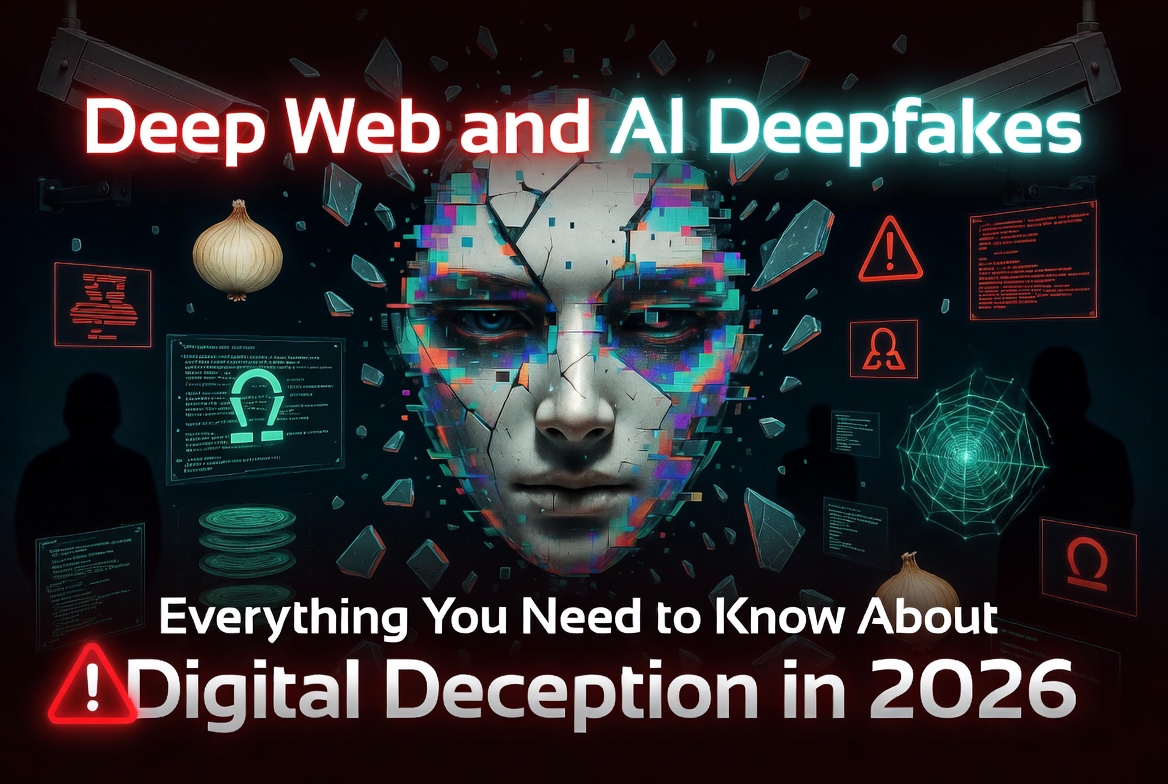
In this guide, I’m going to pull back the curtain on everything. How the Deep Web works. How AI deepfakes are created. How they’re being weaponized. And most importantly—how to protect yourself and spot the fakes.
This is going to get dark. But you need to know. Because ignorance isn’t bliss anymore—it’s dangerous.
Let’s dive in.
Understanding the Deep Web vs Dark Web (They’re Not the Same Thing)
First, let’s clear up the biggest misconception: the Deep Web and the Dark Web are NOT the same thing. Most people use these terms interchangeably. They’re wrong.
The Surface Web (What You Use Every Day)
This is the internet you know. Google, Facebook, YouTube, Amazon, Netflix. Everything indexed by search engines. It represents only about 4-10% of the entire internet. Think of it as the tip of an iceberg.
The Deep Web (90% of the Internet)
The Deep Web is simply any content not indexed by search engines. This includes:
- Your email inbox (Gmail, Outlook)
- Online banking portals
- Medical records
- Subscription content (Netflix, Spotify)
- Company intranets
- Academic databases
- Government databases
- Private social media posts
The Deep Web isn’t illegal or scary. You use it every single day. It’s just password-protected or unindexed content. Totally normal and necessary.
The Dark Web (The Actually Concerning Part)
The Dark Web is a small portion of the Deep Web that’s been intentionally hidden and requires specific software to access—primarily Tor (The Onion Router). This is where things get complicated.
The Dark Web was originally created by the U.S. Naval Research Laboratory to protect intelligence communications. It provides anonymity by routing your connection through multiple encrypted servers worldwide, making it nearly impossible to trace.
What’s Actually on the Dark Web?
Legitimate Uses:
- Journalists protecting sources in authoritarian countries
- Whistleblowers exposing corruption
- Activists organizing in oppressive regimes
- People seeking privacy from surveillance
- Researchers studying cybercrime
- Privacy-focused forums and communities
Illegal Activities (The Part Everyone Talks About):
- Drug marketplaces
- Stolen data sales (credit cards, identities, passwords)
- Hacking services for hire
- Counterfeit documents and currency
- Illegal weapons sales
- Disturbing illegal content I won’t detail here
- And now: AI-generated deepfake services
Here’s the reality: the Dark Web is both a tool for freedom and a haven for criminals. It’s not inherently evil, but it enables both good and terrible things.
How Big Is It?
Nobody knows exactly. Estimates suggest the Deep Web is 400-550 times larger than the Surface Web. The Dark Web is much smaller—probably less than 0.01% of the total internet. But that small percentage has an outsized impact on our world.
How the Dark Web Became Ground Zero for Deepfake Technology
Here’s where things get really concerning. The anonymity of the Dark Web has made it the perfect marketplace for AI deepfake services.
What’s Being Sold Right Now
I’m going to be blunt about what I’ve seen during my research (all done legally through law enforcement channels and academic study):
- “Face Swap” services – Put anyone’s face on any body in photos or videos ($50-500 depending on quality)
- Voice cloning – Create audio of anyone saying anything with just 30 seconds of sample audio ($100-1,000)
- Video deepfakes – Full motion video manipulation ($500-5,000)
- Real-time deepfakes – Live video call manipulation ($1,000+)
- Document forgery – Fake IDs, passports, diplomas with AI-generated photos ($200-2,000)
- “Revenge” services – Creating fake compromising content of specific people (disturbing and illegal)
- Blackmail kits – Packages for extortion using fake evidence
The barrier to entry is shockingly low. You don’t need technical skills. You just need cryptocurrency and an address on the Dark Web.
Real-World Examples That Made Headlines
The 2023 Pentagon Explosion Hoax: An AI-generated image of an explosion at the Pentagon went viral, briefly causing a stock market dip before being debunked. It was created in minutes and caused millions in losses.
Political Deepfakes: During the 2023 Slovak elections, a deepfake audio recording was released two days before voting, allegedly showing a candidate discussing vote manipulation. By the time it was debunked, the damage was done.
Celebrity Scams: Tom Hanks, MrBeast, and Scarlett Johansson have all had their faces used in unauthorized AI-generated advertisements without their permission.
Corporate Espionage: Multiple companies have reported receiving video calls from “executives” requesting urgent wire transfers—all deepfakes.
Why the Dark Web Makes This Worse
On the regular internet, platforms can remove illegal content and ban users. Law enforcement can track activity. There are consequences.
On the Dark Web? Marketplaces operate openly. Sellers have “customer reviews” like Amazon. Forums share techniques and improvements. The technology gets better, cheaper, and more accessible every single day.
And because everything is anonymous and paid for in cryptocurrency, prosecuting these operations is incredibly difficult.

How AI Deepfakes Actually Work (The Technical Truth)
Understanding how deepfakes are created is the first step in learning to detect them. Let me break down the technology in plain English.
The Core Technology: Generative Adversarial Networks (GANs)
Imagine two AI systems competing against each other:
The Generator: Creates fake images/videos
The Discriminator: Tries to identify which images are fake
They battle each other millions of times. The Generator gets better at creating convincing fakes. The Discriminator gets better at spotting them. Eventually, the Generator becomes so good that even the Discriminator can’t tell real from fake.
That’s when the AI is “trained” and ready to create deepfakes that fool humans.
Types of Deepfake Technology
1. Face Swap Deepfakes
The most common type. The AI maps one person’s facial features onto another person’s face in a photo or video. It analyzes:
- Facial structure and proportions
- Skin texture and tone
- Lighting and shadows
- Head movements and angles
- Facial expressions
Modern systems can do this in real-time during video calls. Yes, really.
2. Voice Synthesis (Audio Deepfakes)
AI analyzes voice samples and learns:
- Pitch and tone patterns
- Speaking pace and rhythm
- Accent and pronunciation
- Breathing patterns
- Emotional inflections
With as little as 10-30 seconds of clear audio, AI can generate convincing fake speech. Some systems need only 3 seconds.
3. Full Body Synthesis
The most advanced (and concerning) type. The AI creates an entirely synthetic person who doesn’t exist. Used for:
- Creating fake social media profiles
- Generating fake “testimonials”
- Fabricating “witnesses” for propaganda
- Populating fake dating profiles for scams
4. Lip Sync Deepfakes
Makes a person appear to say words they never said by manipulating mouth movements to match new audio. Particularly dangerous for:
- Political manipulation
- Celebrity misrepresentation
- Creating fake confessions
Tools Being Used (Yes, They’re Publicly Available)
Warning: I’m listing these for educational awareness, not endorsement.
- DeepFaceLab – Open-source face swap tool used for most deepfakes
- FaceSwap – Community-driven deepfake project
- Wav2Lip – Lip synchronization tool
- ElevenLabs – Voice cloning (has restrictions but is sometimes abused)
- Synthesia – Corporate video synthesis (legitimate but can be misused)
- D-ID – Animates photos (mostly legitimate use)
Most scary? Tutorials for all these tools are freely available on YouTube. A motivated teenager can create convincing deepfakes in a weekend.
How Good Are They?
In controlled tests, deepfakes now fool human observers 60-90% of the time depending on quality. Even trained experts struggle with the best examples.
That number is going up. Every month, the technology improves. What was impossible three years ago is trivial today.
How to Detect Deepfakes: The Complete Guide
Alright, enough doom and gloom. Let’s talk about how you can actually SPOT these fakes. I’m going to give you the exact techniques I use professionally.
Visual Red Flags in Deepfake Images
1. Unnatural Eyes and Blinking
This is still the biggest giveaway:
- Blinking patterns: Deepfakes often show irregular or absent blinking in videos
- Eye reflections: Check if both eyes reflect light identically—they should, but deepfakes sometimes get this wrong
- Iris detail: Real irises have complex patterns; AI-generated ones are often too uniform
- Eye direction: In videos, eyes should track objects naturally; deepfake eyes sometimes “wander”
2. Face and Skin Anomalies
- Skin texture: Too smooth (overly plastic-looking) or inconsistent texture
- Facial boundaries: Weird blurring where face meets hair or background
- Teeth: Often too white, too uniform, or weird during speaking
- Wrinkles and pores: May disappear and reappear inconsistently
- Face size: Sometimes slightly too large or small for the head
3. Hair and Accessories
- Hair movement: Doesn’t move naturally with head movements
- Hair boundaries: Weird blurring or transparency at edges
- Glasses: Reflections that don’t make sense, or frames that warp
- Earrings/jewelry: May appear and disappear between frames
4. Background Inconsistencies
- Lighting mismatches: Face lit from one direction, background from another
- Focus issues: Background sharpness that doesn’t match depth of field
- Shadows: Missing, pointing wrong direction, or not matching light source
- Background artifacts: Weird distortions when head moves
5. Hands and Body (Still Problematic for AI)
- Fingers: Extra fingers, missing fingers, fingers merging together
- Hand positions: Anatomically impossible poses
- Body proportions: Head size not matching body
- Clothing: Patterns that warp or text that’s garbled
Audio Red Flags in Voice Deepfakes
1. Breathing and Natural Pauses
- No breathing sounds: Real speech includes subtle breath sounds
- Unnatural pauses: Too perfect or completely absent
- Rhythm issues: Speaking pace that’s too consistent (humans vary)
2. Background Noise
- Too clean: Real recordings have ambient noise; deepfakes are often sterile
- Sudden changes: Background noise that cuts in/out unnaturally
- Acoustic mismatches: Voice sounds like it’s in a different space than visible room
3. Vocal Artifacts
- Robotic quality: Slight mechanical sound or excessive smoothness
- Mouth sound issues: Missing lip smacks, tongue clicks, swallowing sounds
- Emotional inconsistency: Voice emotion doesn’t match facial expression
Video-Specific Red Flags
1. Temporal Inconsistencies
- Frame-to-frame glitches: Face quality that varies wildly between frames
- Flickering: Subtle flickering around face boundaries
- Morphing: Features that seem to subtly shift
2. Compression Artifacts
- Different compression: Face appears more compressed than background
- Quality mismatches: Face is higher/lower quality than surroundings

Free Tools to Detect Deepfakes (Actually Useful)
You don’t have to rely solely on your eyes. Here are the best detection tools available right now:
1. Deepware Scanner (Free Browser Extension)
What it does: Analyzes videos on YouTube, Twitter, and Facebook to detect deepfakes
How to use: Install the browser extension, browse normally. It automatically scans videos and alerts you to potential fakes.
Accuracy: About 70-80% on obvious fakes, lower on sophisticated ones
Best for: Casual browsing and social media
2. Sensity (Enterprise/Free Trial)
What it does: Advanced deepfake detection using multiple AI models
How to use: Upload video or image for analysis
Accuracy: 85-95% depending on deepfake quality
Best for: Verification of suspicious content
3. Microsoft Video Authenticator
What it does: Analyzes photos and videos frame-by-frame
How to use: Available through partnership programs (not fully public)
Accuracy: High (90%+) but requires good quality source material
Best for: Professional verification
4. InVID (Free Tool for Journalists)
What it does: Reverse image search, metadata analysis, magnification
How to use: Upload image/video or analyze from URL
Website: InVID Project
Best for: Investigative research and verification
5. FotoForensics (Free Image Analysis)
What it does: Error Level Analysis (ELA) to detect image manipulation
How to use: Upload image, view analysis showing edited regions
Website: FotoForensics
Best for: Detecting edited photos
6. Reality Defender (Chrome Extension)
What it does: Real-time scanning of web content for synthetic media
How to use: Install extension, it runs automatically
Best for: Continuous protection while browsing
7. TinEye (Reverse Image Search)
What it does: Finds where an image appears online
How to use: Upload image or paste URL to find sources
Website: TinEye
Best for: Verifying if an image is stolen or manipulated
Manual Techniques (No Tools Needed)
The Zoom Test
Zoom way in on suspicious areas (eyes, teeth, ears, fingers). Deepfakes often fall apart under magnification. Look for:
- Blurred boundaries
- Repeated patterns that shouldn’t repeat
- Details that become nonsensical up close
The Frame-by-Frame Analysis
For videos, use YouTube’s period (.) and comma (,) keys to move frame by frame. Deepfakes often have inconsistencies between frames that are invisible at normal speed.
The Metadata Check
Right-click image > Properties (Windows) or Get Info (Mac). Check:
- Creation date (does it match the supposed event date?)
- Camera information (is it consistent?)
- File modification history (signs of editing)
The Context Verification
Ask yourself:
- Who originally posted this?
- What’s their credibility?
- Can I find this content from reliable sources?
- Does the content match known facts?
- Is the timing suspicious (released right before election, court date, etc.)?
Real-World Deepfake Scams You Need to Know About
Let me walk you through the most common deepfake scams happening RIGHT NOW so you know what to watch for.
1. The “Boss Scam” (CEO Fraud)
How it works: Scammers use voice cloning or video deepfakes to impersonate your boss/CEO. They contact you via video call or voice message requesting an urgent wire transfer or sensitive information.
Real example: A UK energy company transferred $243,000 after the CEO (deepfake voice) called requesting urgent payment to a supplier.
How to protect yourself:
- Establish a verification phrase/code with your boss for unusual requests
- Call back on a known number (don’t use number from suspicious call)
- Verify through a second channel (email, in-person, text to known number)
- Be suspicious of ANY request for urgent money transfers
- Never provide sensitive information based on a single contact
2. The “Grandparent Scam” (Family Emergency)
How it works: Scammers use voice cloning to impersonate a grandchild/family member in distress. “Grandma, I’m in jail. I need bail money. Please don’t tell mom and dad.”
Why it works: Plays on emotion and urgency. Elderly targets often don’t question the voice because it sounds exactly right.
How to protect yourself/elderly family:
- Establish a family code word for emergencies
- ALWAYS verify by calling the person directly on their known number
- Ask questions only the real person would know
- Never send money through untraceable methods (wire transfer, gift cards, cryptocurrency)
- Call other family members to verify the situation
3. The “Celebrity Endorsement” Scam
How it works: Deepfake videos of celebrities promoting cryptocurrency, investment schemes, or products they’ve never actually endorsed.
Recent examples: Tom Hanks warning fans about fake dental ads using his likeness. MrBeast addressing fake iPhone giveaway scams using his face.
How to protect yourself:
- Check the celebrity’s OFFICIAL social media for confirmation
- Be skeptical of any celebrity promoting financial opportunities
- Look for verified checkmarks on social media
- Research the company/product independently
- If it seems too good to be true, it absolutely is
4. The “Romantic Interest” Scam (Catfishing 2.0)
How it works: Scammers create entire fake personas using AI-generated faces and voices. They develop “relationships” online, then request money for emergencies.
How to protect yourself:
- Request live video calls (not pre-recorded)
- Ask them to perform specific actions on camera (hold up fingers, touch their nose)
- Use reverse image search on their photos
- NEVER send money to someone you haven’t met in person
- Be skeptical if they always have excuses to avoid video calls
5. The “Evidence Fabrication” Scam (Blackmail/Extortion)
How it works: Scammers create compromising deepfake images/videos of you and threaten to release them unless you pay.
Why it’s effective: Even fake evidence can ruin reputations if it goes viral before being debunked.
How to protect yourself:
- DON’T PAY (paying encourages more extortion)
- Document everything (screenshots, emails, messages)
- Report to local police and FBI (file IC3 complaint)
- Contact a lawyer immediately
- Preemptively inform close friends/family about the scam
- Consider making a public statement if threatened
6. The “Verification Scam” (Fake Authentication)
How it works: Scammers use deepfake technology to bypass biometric security (facial recognition, voice verification) on banking or cryptocurrency accounts.
How to protect yourself:
- Enable multi-factor authentication (MFA) on ALL accounts
- Use authenticator apps, not SMS (SIM swapping is common)
- Set up transaction alerts for all financial accounts
- Use strong, unique passwords (password manager recommended)
- Regularly monitor account activity

How to Protect Yourself: The Complete Defense Strategy
Awareness is the first step. But you need a comprehensive protection plan. Here’s exactly what to do:
Level 1: Basic Protection (Everyone Should Do This)
1. Secure Your Digital Footprint
- Limit public photos/videos: Less source material = harder to create convincing deepfakes of you
- Review privacy settings: Make Instagram, Facebook, TikTok private or at least “friends only”
- Google yourself regularly: See what information/media is publicly available about you
- Request removal: Use Google’s content removal tool for unwanted images
2. Enable Security on All Accounts
- Two-factor authentication (2FA): Use authenticator apps (Google Authenticator, Authy), NOT SMS
- Unique passwords: Every account gets a different password (use a password manager)
- Security questions: Use false answers that only you know (don’t use real mother’s maiden name)
- Transaction alerts: Get notified immediately of any account activity
3. Establish Verification Protocols
- Family code word: Create a secret word only family knows for emergencies
- Business verification: Establish protocols at work for unusual financial requests
- Callback procedures: Always verify unusual requests through a second channel
Level 2: Advanced Protection (For High-Risk Individuals)
If you’re a public figure, executive, high net worth individual, or handle sensitive information:
1. Digital Rights Protection
- Register copyrights: Copyright your image/voice legally
- Use watermarking: Add invisible watermarks to official photos/videos
- Monitoring services: Use services that scan the internet for unauthorized use of your likeness
- Takedown procedures: Have legal team ready with DMCA takedown templates
2. Technical Defenses
- VPN usage: Encrypt internet traffic (use reputable VPNs like NordVPN or ExpressVPN)
- Encrypted communications: Use Signal or ProtonMail for sensitive conversations
- Secure devices: Keep all software updated, use antivirus
- Biometric backup: Don’t rely solely on facial recognition; use fingerprint + password
3. Reputation Management
- Media monitoring: Track mentions of your name online
- Crisis PR plan: Have a response ready if deepfakes of you appear
- Verified accounts: Get verified on social platforms you use
- Official website: Maintain a site that can quickly debunk false content
Level 3: Community Protection (Help Others Stay Safe)
1. Educate Your Circle
- Share this information: Send this guide to family and friends
- Elderly relatives: Spend time teaching them about deepfake scams specifically
- Workplace training: Request cybersecurity training at your company
2. Responsible Sharing
- Verify before sharing: Don’t spread unverified viral content
- Label uncertainty: If you’re not sure something is real, say so
- Correct mistakes: If you shared something fake, delete and post a correction
3. Report Suspicious Content
- Social platforms: Report deepfakes to Facebook, Twitter, YouTube, TikTok
- Law enforcement: File reports with FBI Internet Crime Complaint Center (IC3.gov)
- Media literacy organizations: Report to groups like FactCheck.org
The Legal Landscape: What’s Being Done About Deepfakes
Governments worldwide are scrambling to address the deepfake threat. Here’s where we stand legally:
United States
Federal Laws
- DEEPFAKES Accountability Act (proposed): Would require watermarking of AI-generated content
- Malicious Deep Fake Prohibition Act: Makes certain deepfakes illegal
- SHIELD Act: Protects victims of non-consensual deepfake pornography
- Currently: No comprehensive federal deepfake law yet, but multiple bills in progress
State Laws
- California: AB 730 makes campaign-related deepfakes illegal within 60 days of election
- Texas: Criminalizes deepfakes created to harm or defraud
- Virginia: Revenge porn laws extended to deepfakes
- New York: Right to publicity laws being updated for deepfakes
European Union
- AI Act: Requires disclosure of AI-generated content
- GDPR: Provides some protection regarding unauthorized use of personal data/images
- Copyright Directive: Addresses unauthorized use of likenesses
Other Countries
- UK: Online Safety Bill includes deepfake provisions
- China: Requires deepfakes to be labeled as synthetic
- South Korea: Heavy penalties for malicious deepfakes
- Australia: Considering legislation similar to EU approach
Platform Policies
Social Media Responses
- Facebook/Instagram (Meta): Bans deepfakes that mislead about what someone said; some exceptions for satire
- Twitter/X: Labels synthetic/manipulated media; may remove in severe cases
- YouTube: Requires disclosure of realistic altered content
- TikTok: Bans synthetic media that misleads viewers
- Reddit: Banned deepfake pornography; allows labeled deepfakes
The Challenge
Laws are struggling to keep pace with technology. By the time legislation passes, the tech has already evolved. The Dark Web operates outside traditional legal jurisdiction. Enforcement is incredibly difficult.
The reality? Legal protection exists but is incomplete. You can’t rely solely on laws to protect you. Personal vigilance is essential.
The Future: What’s Coming Next (And It’s Terrifying)
As someone who tracks this technology professionally, I need to be honest about where this is heading. It’s not pretty.
Near Future (2024-2025)
Real-Time Deepfakes Will Become Mainstream
Currently, creating convincing deepfakes takes hours or days. Within a year, we’ll have apps that do it in real-time during video calls with zero lag. You won’t be able to trust ANY video call by default.
Voice Cloning Will Require 1 Second of Audio
Right now, voice cloning needs 10-30 seconds. New models are training on just 1 second. That means any video you’ve posted online, any voicemail, any TikTok—enough for perfect cloning.
Deepfakes Will Become Indistinguishable
The artifacts and tells I’ve described? They’re disappearing fast. By 2025, even professional forensic tools will struggle with the best deepfakes.
Medium Future (2025-2027)
Personalized Deepfake Attacks
Imagine receiving a video call from your spouse, parent, or child. It sounds like them. It looks like them. It references specific memories only they would know (scraped from your social media and communications).
But it’s AI. And it’s asking for money, passwords, or sensitive information.
Mass-Scale Political Manipulation
Elections will be fought not just with ads, but with thousands of micro-targeted deepfake videos showing candidates “saying” things specifically designed to outrage specific demographic groups.
Released hours before voting, debunked hours after. The damage already done.
Evidence Becomes Worthless
When anyone can create perfect fake video/audio of anything, how do courts accept evidence? How do journalists verify sources? How do we know what’s real?
We’re heading toward an “epistemic crisis”—a world where determining truth becomes nearly impossible.
Far Future (2027+)
Synthetic Identities
Entirely AI-generated people with complete online histories, social media presence, and interactions. Impossible to distinguish from real humans. Used for:
- Massive influence campaigns
- Fake witness testimonies
- Fabricated social proof for products/services
- Creating false consensus on issues
The “Liar’s Dividend”
This is the scariest part. When deepfakes become widespread, real videos can be dismissed as fakes.
Caught on camera doing something illegal or unethical? Just claim it’s a deepfake. In a world where perfect fakes exist, plausible deniability becomes bulletproof.
Potential Solutions (If We Act Now)
- Content authentication standards: Cameras that cryptographically sign photos/videos at creation
- Blockchain verification: Immutable records of authentic media
- AI detection advancement: Arms race between creation and detection
- Legal frameworks: Comprehensive international laws with real enforcement
- Media literacy: Widespread education on critical thinking and verification
But these solutions require cooperation between governments, tech companies, and citizens. And time is running out.
What You Can Do RIGHT NOW

Feeling overwhelmed? I get it. But paralysis helps no one. Here’s your action plan:
This Week
- Audit your social media: Make Instagram, Facebook, TikTok private (30 minutes)
- Enable 2FA on critical accounts: Email, banking, social media (1 hour)
- Create family verification code: Share a secret word with close family (15 minutes)
- Install deepfake detection extensions: Add Reality Defender or Deepware Scanner (10 minutes)
- Educate one person: Share this article with someone who needs it (5 minutes)
This Month
- Set up password manager: Use LastPass, 1Password, or Bitwarden
- Review and update all passwords: Unique for every account
- Check what info is public about you: Google yourself, use Spokeo, request removal
- Set up financial alerts: Get notified of all transactions
- Create an emergency response plan: What to do if you’re targeted
Ongoing
- Question everything: Especially content designed to make you angry or afraid
- Verify before sharing: Don’t spread unconfirmed viral content
- Stay updated: Technology evolves; your knowledge should too
- Support good actors: Platforms and organizations fighting misinformation
- Advocate for legislation: Contact representatives about deepfake laws
Resources and Further Learning
Detection Tools
- Deepware Scanner – Browser extension for video analysis
- FotoForensics – Image manipulation detection
- InVID – Journalist verification toolkit
- TinEye – Reverse image search
Reporting
- FBI Internet Crime Complaint Center – Report cybercrimes
- FTC Complaint Assistant – Report scams
- IdentityTheft.gov – Identity theft recovery
Educational Resources
- MIT Media Lab – Detect Fakes
- FactCheck.org – Fact-checking resource
- Snopes – Debunking misinformation
- Harvard Berkman Klein Center – Digital security research
Privacy Tools
- NordVPN – Encrypted browsing
- Signal – Encrypted messaging
- ProtonMail – Encrypted email
- Bitwarden – Password manager
Stay Informed
- Wired – Deepfakes Coverage
- MIT Technology Review
- Krebs on Security
- Bruce Schneier’s Blog – Security expert insights
Final Thoughts: Hope in the Darkness

I know this article has been heavy. Dark, even. And I won’t sugarcoat it—the deepfake threat is real, growing, and dangerous.
But here’s what I want you to remember: knowledge is power.
Five years ago, most people didn’t know deepfakes existed. Today, you do. You know how they work, how to spot them, and how to protect yourself. That’s huge.
Yes, the technology will keep improving. But so will detection methods. So will public awareness. So will legal frameworks.
We’re in an arms race between deception and truth. And truth has advantages: it’s consistent, verifiable, and has billions of defenders.
Every person who reads this article and shares it with others makes us collectively stronger. Every company that implements verification protocols raises the bar. Every law passed creates consequences for bad actors.
The fight isn’t lost. It’s just beginning.
And you’re now part of the defense.
What you do with this information matters. Protect yourself. Protect your family. Educate your community. Question suspicious content. Verify before sharing. Report bad actors.
Be skeptical, but not cynical. Trust, but verify. Stay informed, but don’t live in fear.
The future isn’t written yet. We get to help write it.
And that starts with YOU, right now, today.
Stay safe out there. Stay smart. Stay vigilant.
The truth is worth fighting for.