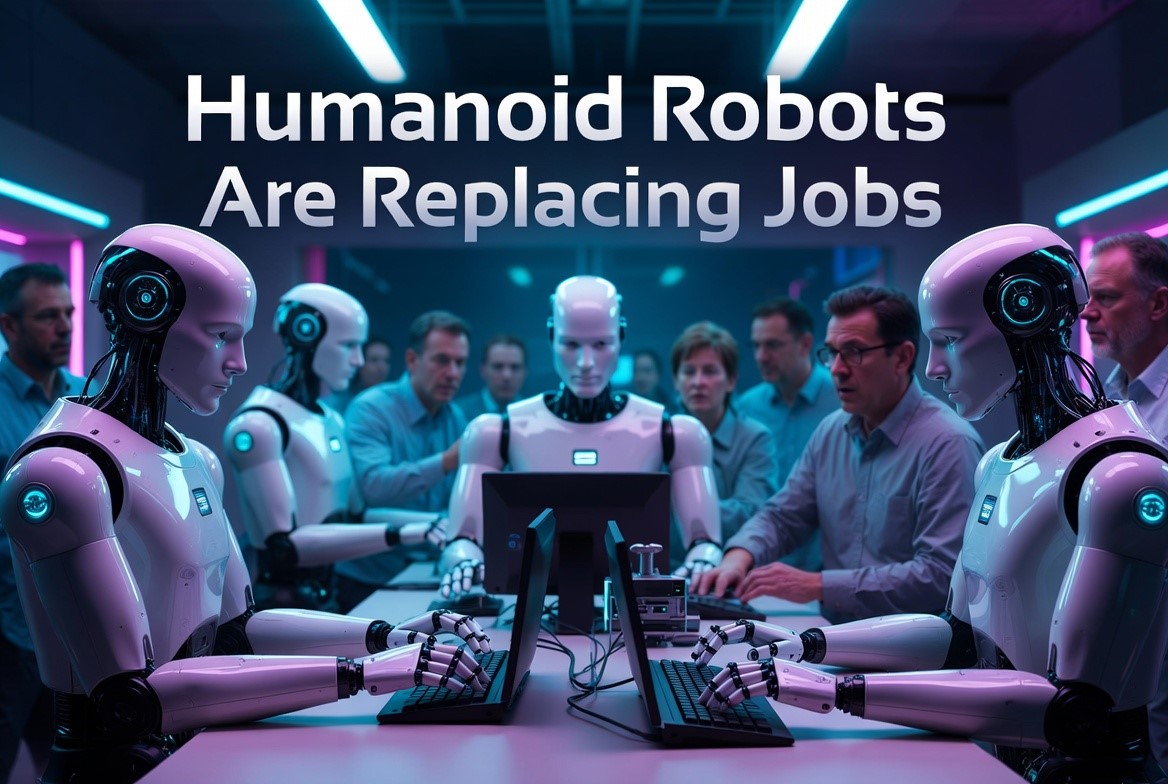
Atlas builds Hyundais. Figure 03 runs factories overnight with zero human supervision. A Chinese robot just outran every human who ever lived. This is not a demo — this is happening right now.

Humanoid robots are no longer prototypes — they are clocking in for real shifts at real companies. (Photo: Unsplash)
The Moment Everything Became Real
There’s a specific moment when a technology stops being a promise and starts being a fact. For humanoid robots, I think that moment was sometime in early 2026 — and most people completely missed it.
It wasn’t one single headline. It was a stack of them. A robot loading bags at a major international airport on a three-year operational commitment — not a press stunt. A humanoid running a car factory overnight without a single human in the building. A Chinese robot completing a half-marathon faster than any human ever has. Tesla announcing production this summer. AgiBot shipping its 10,000th unit.
Each story, in isolation, sounds like hype. Together, they paint a picture that’s hard to ignore: humanoid robots have crossed the line from experimental to operational. They are clocking in for real shifts, at real companies, doing real work.
The Numbers That Tell the Story
Before we get into the specifics, here’s the scale of what’s happening right now:
These are not projections. They are verified, reported figures from company announcements, Bloomberg, and industry trackers. The robotics industry isn’t approaching a tipping point — it’s already past one.

Modern humanoids are built for unstructured environments — not just fixed assembly stations. (Photo: Unsplash)
Robots Are Loading Bags at Tokyo’s Busiest Airport
Japan Airlines made a quiet announcement in May 2026 that the industry is still processing. The carrier deployed humanoid robots at Tokyo’s Haneda Airport — one of the world’s busiest, handling 85.9 million passengers every year — for baggage loading, container transport, and aircraft cabin cleaning.
What makes this significant isn’t the technology. It’s the commitment. JAL signed a three-year operational agreement. This isn’t a press conference stunt. It’s a multi-year bet that these machines are reliable enough to be counted on daily in a safety-critical environment where airlines are famously cautious.
The robots used are Unitree Robotics-based humanoid platforms, costing approximately $15,400 per unit — cheaper than a decent used car. The reason Japan is moving faster than almost anyone else? Japan’s working-age population is projected to decline by 31% between 2023 and 2060. The labor shortage isn’t coming — it’s already here.
“Airports were built for people, not wheeled machines. Humanoids fit the infrastructure that already exists.” — KraneShares Humanoid Robotics Report, May 2026
That insight is deceptively important. Every warehouse, factory, hospital, and airport on Earth was designed with a human body in mind — steps, handles, corridors, shelves at human height. A humanoid robot can use all of it without rebuilding anything. That’s a trillion-dollar advantage over specialized machines.
Figure 02 Helped Build 30,000 BMWs — And It’s Just Getting Started
For 11 months, two Figure AI humanoid robots worked the floor of BMW’s Spartanburg, South Carolina plant. When the deployment data was tallied, the results were clear:
- Contributed to the production of over 30,000 BMW X3 vehicles
- Loaded more than 90,000 sheet metal components
- Accumulated approximately 1,250 operational hours on 10-hour weekday shifts
BMW is now expanding the pilot to its Leipzig, Germany facility. And Figure AI isn’t standing still. Their latest model, Figure 03, has demonstrated something genuinely unprecedented: 24/7 fully autonomous operation running overnight with zero human supervision. Including jogging outdoors at around 2 meters per second.
CEO Brett Adcock has outlined an almost audacious 2026 roadmap: factory deployments this year, robots building other robots within 24 months, and home robots managing household chores in completely new environments by year-end.
A Robot Just Ran a Half-Marathon Faster Than Any Human Ever Has
In April 2026, something happened in Beijing that still sounds like it came from a science fiction novel. A humanoid robot named “Lightning,” built by Chinese smartphone maker Honor, participated in the Beijing E-Town Half-Marathon alongside human runners.
It completed the 21-kilometer course in 50 minutes and 26 seconds.
The human half-marathon world record — set by a world-class athlete at peak condition — is 57 minutes and 31 seconds. Lightning beat it by more than seven minutes.
Now, to be fair: running a half-marathon doesn’t mean the robot can fold laundry or perform surgery. Speed and endurance in a controlled physical task is a specific capability. But it tells us something important: these machines are getting better faster than almost anyone predicted.

The mechanical dexterity of modern humanoids has improved dramatically in just the past 18 months. (Photo: Unsplash)
Who’s Building What — The Key Players in 2026
| Company | Robot | Status in 2026 | Key Deployment |
|---|---|---|---|
| Figure AI | Figure 03 | 🟢 Active deployments | BMW Spartanburg + Leipzig |
| Boston Dynamics | Electric Atlas | 🟢 All 2026 units sold out | Hyundai + Google DeepMind |
| Tesla | Optimus Gen 3 | 🟡 Production summer 2026 | Fremont factory (internal) |
| Unitree Robotics | Multiple models | 🟢 5,500+ units shipped | Japan Airlines (Haneda) |
| AgiBot (China) | Various | 🟢 10,000th unit shipped | Industrial & warehouse |
| Apptronik | Apollo | 🟡 Scaling with $935M Series A | Toyota (Canada) |
| Agility Robotics | Digit | 🟢 Active | Toyota Motor Canada |
What’s striking is how quickly this table would have looked different six months ago. Boston Dynamics’ Atlas went from a research robot to a sold-out commercial product. Figure went from a startup with demos to a company with 11 months of BMW factory data. The acceleration is real and it’s not slowing down.
What This Actually Means for Your Job
This is the question everyone’s thinking but fewer people ask directly. So let’s be honest about it.
In the short term (next 2–3 years): humanoid robots will replace specific physical tasks, not entire jobs. Baggage loading, sheet metal handling, repetitive assembly work, warehouse transport — these are things robots are genuinely good at right now. If your entire job is one of these tasks, that’s a real and honest concern.
In the medium term (3–7 years): the robots get cheaper, smarter, and more reliable. Tasks that currently require human judgment start falling within robot capability. The blast radius expands.
The honest truth: people least at risk combine physical presence with complex judgment, social intelligence, or creative problem-solving. People most at risk are doing physically repetitive work in structured, predictable environments. That’s a significant portion of the global workforce — and it deserves honest conversation, not reassuring platitudes.
Jobs Most Likely to Be Affected First
- Warehouse pickers and packers
- Assembly line workers doing repetitive physical tasks
- Airport and logistics ground handlers
- Basic manufacturing and material handling
- Cleaning and janitorial in large facilities
Jobs Least Likely to Be Affected Soon
- Healthcare workers (complex judgment + emotional intelligence)
- Teachers and educators
- Creative professionals
- Plumbers, electricians (variable, unstructured environments)
- Robot deployment and maintenance specialists — these jobs are growing fast
📅 Timeline — Major Humanoid Milestones in 2026
-
January 2026 — CES Las Vegas
Boston Dynamics unveils production-ready electric Atlas. All 2026 units committed immediately to Hyundai and Google DeepMind. 1X’s NEO humanoid begins delivering to early home users.
-
February 2026
Apptronik closes a Series A at over $935 million. Agility Robotics and Toyota announce deployment of Digit robots at the Woodstock, Ontario manufacturing facility.
-
March 2026
AgiBot ships its 10,000th humanoid robot, scaling from 1,000 units just months earlier. Amazon acquires Fauna Robotics. NVIDIA GTC 2026 features major robotics platform announcements.
-
April 2026
Chinese humanoid “Lightning” completes the Beijing E-Town Half-Marathon in 50 minutes 26 seconds — beating the human world record. Figure 03 demonstrates 24/7 autonomous overnight factory operation.
-
May 2026
Japan Airlines deploys Unitree-based humanoids at Tokyo Haneda Airport on a three-year contract for baggage and cabin operations. McKinsey calls the robotics supply chain “the most underappreciated constraint on humanoid scale.”
-
Summer 2026 — Upcoming
Tesla targets production start for Optimus Gen 3 at Fremont, powered by the AI5 chip. Automate 2026 in Chicago features the first dedicated Humanoid Robot Forum and Pavilion sponsored by NVIDIA.
📬 Get Our Weekly AI & Robotics Briefing
One email. The three biggest developments in AI and robotics this week. No hype, no filler — just the signal worth your attention.
Subscribe Free →❓ Frequently Asked Questions
The Bottom Line
I want to resist the temptation to end with either dystopian panic or empty reassurance. Both would be dishonest.
What’s actually happening is this: a technology that was theoretical five years ago, experimental three years ago, and prototype-only two years ago is now operational, commercially deployed, and scaling fast. The pace of change is not slowing. If anything, Figure 03, the JAL commitment, and the marathon result suggest the curve is bending sharply upward.
That creates real opportunity — for investors, for robotics professionals, for entrepreneurs building on this infrastructure. And it creates real disruption — for workers in physical-task jobs who deserve honest information, not talking points. The smartest thing anyone can do right now is pay attention with clear eyes and a genuine willingness to adapt. That’s always been the best strategy in a changing world, and 2026 is no exception.