How Much Do AI Professionals Make a Year? Real Numbers and What’s Changed
Let’s cut right to the chase—AI professionals are pulling in serious money these days. We’re talking six figures for many positions, with some specialized roles commanding salaries that make traditional corporate jobs look downright modest.
But here’s the thing: the salary landscape in artificial intelligence is wildly variable. Your paycheck depends on location, experience level, specific role, and whether you’re working for a scrappy startup or a tech giant like Google or Meta. It’s not a one-size-fits-all situation.
The Average AI Professional Salary Range
According to recent Forbes reporting on tech salaries, entry-level AI professionals typically earn between $80,000 and $120,000 annually. That’s already above the median American household income, and you’re just starting out.
Mid-level professionals—we’re talking about someone with 5-10 years of experience—usually see salaries ranging from $150,000 to $250,000. This is where things get interesting. You’ve got the experience to be valuable, but you’re not yet at the senior leadership level.
Senior AI professionals, machine learning engineers, and AI architects? They’re looking at $200,000 to $400,000+ annually. Some elite positions at top tech companies push even higher, especially when you factor in stock options and bonuses.
Breaking Down Different AI Roles and Their Salaries
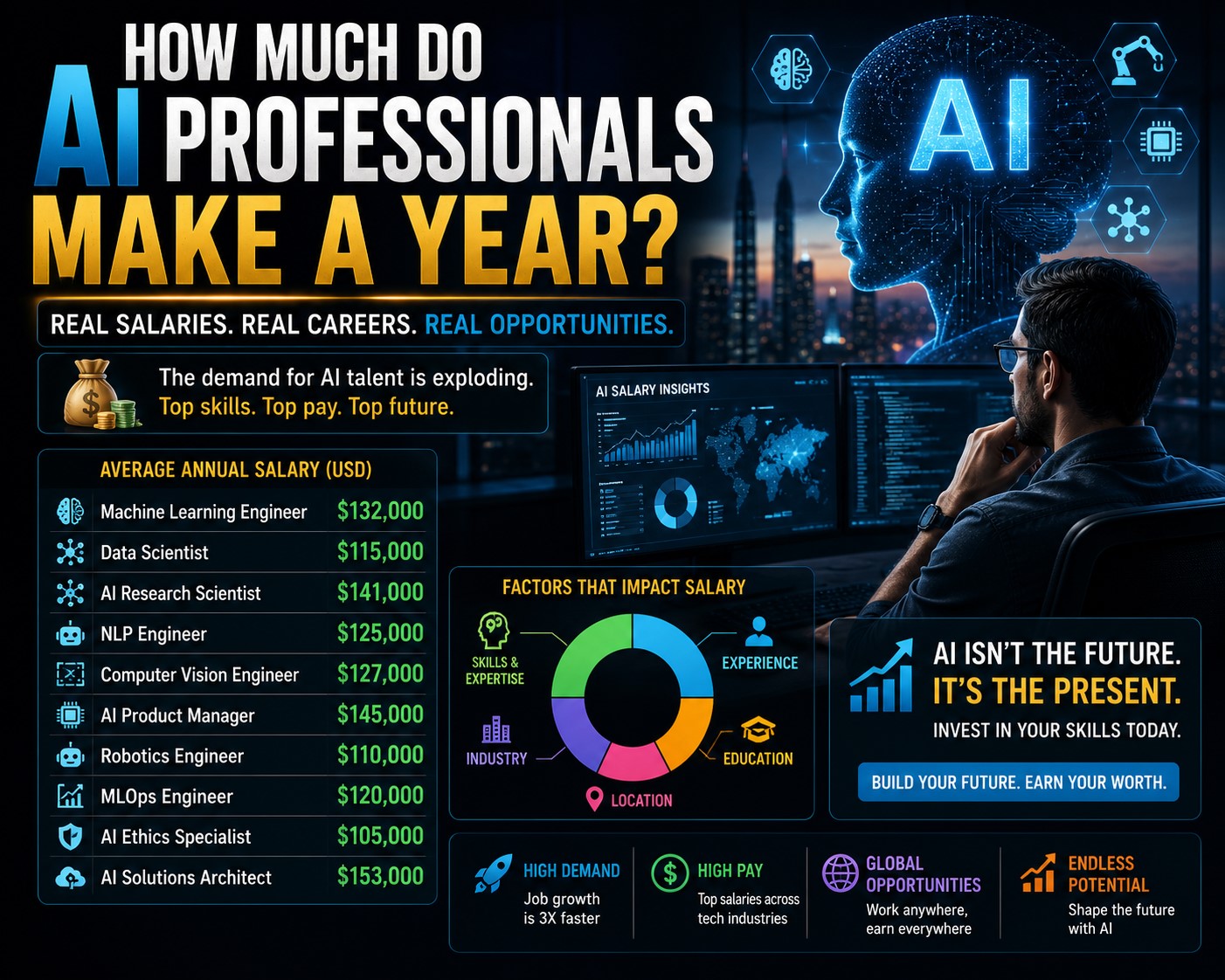
Not all AI jobs pay the same, obviously. Let me break down what different positions typically command:
- Machine Learning Engineer: $130,000–$300,000. These folks build and maintain the algorithms that power AI systems. Their skills are in high demand, especially if they can work with large datasets and cloud infrastructure.
- Data Scientist: $110,000–$250,000. They’re the explorers of the data world, finding patterns and insights. The salary tends to be slightly lower than ML engineers, but top performers at major companies still hit six figures easily.
- AI Research Scientist: $150,000–$350,000+. These are the innovators pushing the boundaries of what AI can do. If you’re doing cutting-edge research at places like OpenAI or DeepMind, you’re looking at the higher end.
- Natural Language Processing (NLP) Specialist: $140,000–$320,000. With the explosion of large language models, NLP skills are hotter than ever right now.
- Computer Vision Engineer: $130,000–$280,000. Building systems that can “see” and interpret images is valuable work, and companies pay accordingly.
- AI Ethics Specialist: $120,000–$250,000. This is a newer field that’s gaining importance as companies worry more about responsible AI. The pay reflects the relative newness and specialization.

Location Matters More Than You’d Think
An AI engineer in San Francisco isn’t just making more money than one in Cleveland—they’re making substantially more. We’re talking 30-50% difference for the exact same role and experience level.
Silicon Valley and San Francisco remain the salary leaders. New York, Seattle, and Boston also command premium salaries. Remote work has shifted things somewhat, but location still heavily influences what you’ll earn.
Interestingly, some tech hubs like Austin and Denver are starting to offer competitive salaries while having a lower cost of living than the Bay Area. If you’re flexible on location, you might be able to negotiate better work-life balance without sacrificing too much income.
The Company Size Factor
Big tech companies—your Googles, Metas, Microsofts—tend to pay more than startups. That’s just the reality. A Google AI researcher might make $250,000 base salary plus $300,000 in stock options. At a Series B startup? You’re looking at maybe $160,000 base plus equity that might be worth zero or might be worth millions.
That said, startup folks often get richer faster if the company succeeds. It’s a risk-reward situation. You can’t tell someone working at a failed startup making $150,000 that they made a bad choice if they could’ve made $200,000 at Google—unless that startup went public and their options made them millions. Hindsight is frustratingly clear.
Experience and Education Impact Salaries
Here’s something that might surprise you: formal education matters, but practical experience matters more in AI. A PhD in machine learning from MIT probably gets you a higher starting salary than a bootcamp graduate. But five years of shipping production ML models? That’s worth more than any degree.
That said, the salary bump from a master’s degree to a PhD is usually modest—maybe 5-10% higher base salary. What really moves the needle is demonstrating that you can solve real problems and ship code that actually works.
Entry-level positions increasingly accept qualified candidates without advanced degrees, especially if they can prove their skills through projects, portfolios, or certifications. HubSpot’s research on tech hiring shows that many companies are becoming more flexible about educational requirements as the talent shortage intensifies.

What About Benefits and Total Compensation?
Base salary is only part of the story. At major tech companies, stock options and bonuses can double or even triple your total compensation package. That $200,000 salary? Add $200,000 in stock vesting over four years and a $50,000 bonus, and you’re actually looking at an effective annual comp of around $300,000 when you spread it out.
Startups often compensate differently. Lower base salary, but percentage equity that could be worth a lot someday. Health insurance, 401k matching, and other benefits vary wildly depending on where you work.
The Skills That Command the Highest Salaries
Not all AI skills pay equally. Deep expertise in large language models, transformer architectures, and reinforcement learning tends to pay more right now. That’s simply supply and demand—fewer people know how to do this cutting-edge work.
Skills in deployment, MLOps, and production machine learning are increasingly valuable too. Anyone can train a model in a notebook. Getting that model to production, keeping it accurate over time, and scaling it to millions of users? That’s rare and expensive.
The Industry Trends Affecting Salaries
AI salaries have risen dramatically over the past three years. The shortage of qualified AI talent combined with increased demand from literally every industry has created a candidate’s market. Companies are bidding against each other for talent, which drives salaries up.
That said, market corrections happen. If the AI bubble bursts or hiring slows down significantly, salaries might plateau or even dip. But that doesn’t seem likely in the near term—demand still vastly exceeds supply.
Should You Pivot to AI for the Money?
Okay, real talk. The salary is attractive, but don’t jump into AI solely because the paychecks are fat. You’ll be competing against extremely smart people who genuinely enjoy this work. If you’re just chasing money, it’ll show, and you probably won’t be competitive anyway.
That said, if you’re interested in data, algorithms, and building systems, the financial upside is definitely there. It’s one of the few fields where competence is directly rewarded with higher compensation.
The best move? Develop genuine expertise in an AI domain that interests you, contribute to open-source projects, and build a portfolio that demonstrates real skills. The salary will follow naturally.
Bottom Line
AI professionals make excellent money—significantly more than most other fields. Entry-level positions start around $80,000-$120,000, mid-level roles hit $150,000-$250,000, and senior positions often exceed $300,000 when you factor in the full compensation package.
Your actual salary depends on location, company size, specific role, and the market value of your particular skills. But in general, if you’re good at this work, you’ll be well compensated.
Ready to explore opportunities in this field? AI Nidox can help you navigate the AI career landscape and find the right opportunity for your skills and experience.