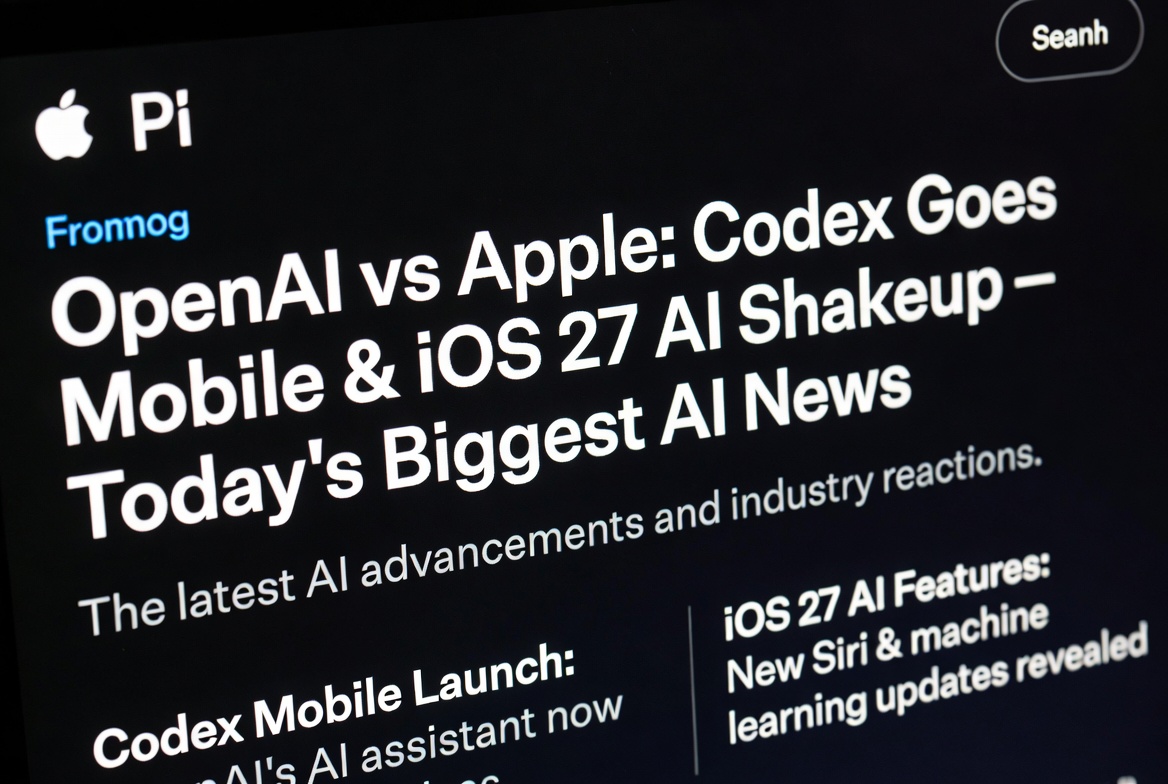
OpenAI vs. Apple, Codex Goes Mobile, and the iOS 27 AI War Nobody Saw Coming
The AI world had a very busy week. Here’s everything that happened — explained clearly, without the jargon, so you can actually understand what it means for you.

The OpenAI–Apple relationship is fracturing — just as Apple prepares to open its doors to Claude and Gemini. (Photo: Unsplash)
Why This Week in AI Is Different
I’ve been covering tech news for a long time. And every once in a while, a week comes along where the number of consequential things happening simultaneously is just a lot to process. This is one of those weeks.
We have OpenAI apparently preparing legal action against one of its most important partners. A coding tool that was desktop-only suddenly landing on your iPhone. Apple quietly dismantling the exclusive AI deal everyone assumed was permanent. And a brand-new model that’s supposed to think more autonomously than anything OpenAI has shipped before.
Let me walk you through each one — what actually happened, why it matters, and what it means for you personally.
OpenAI Is Considering Suing Apple — Here’s Why
This one caught nearly everyone off guard. OpenAI has reportedly hired outside legal counsel to explore suing Apple over their ChatGPT integration deal — the agreement that placed ChatGPT inside Siri and Apple’s Visual Intelligence feature starting in 2024.
So what went wrong? According to internal reporting, OpenAI expected billions of dollars in revenue from the deal. The idea was simple: having ChatGPT baked into every iPhone would drive massive subscriber growth. Instead, the integration turned out to be hard to find, users rarely triggered it by name, and the financial returns have reportedly been “disappointing.”
“Unlike the multi-billion-dollar deal Apple maintains with Google for search, the OpenAI partnership involved no large direct payments, with both sides instead relying on mutual strategic benefits that OpenAI now claims have not materialised.” — LatestLY, May 15, 2026
OpenAI’s frustration goes beyond the numbers. The company also feels Apple didn’t do enough to promote the ChatGPT integration — no prominent placement, no advertising push, no real effort to get people actually using it.
The situation is further complicated by OpenAI’s own ambitions in hardware. The company recently acquired a device startup co-founded by Jony Ive — the legendary Apple designer behind the iPhone — and has been actively poaching Apple engineers. Understandably, that hasn’t gone over well in Cupertino.
Why This Matters for Regular Users
If you use an iPhone and rely on AI features, a messy OpenAI–Apple breakup could affect which AI model powers your Siri in the short term. It could also accelerate Apple’s push toward other providers — which brings us to story three.

Codex can now be monitored and directed from a smartphone while it continues running code on your Mac. (Photo: Unsplash)
Codex Is Now on Your Phone — And It’s Kind of a Big Deal
On May 14, OpenAI announced that Codex — its AI coding agent — is now accessible directly from the ChatGPT mobile app on both iPhone and Android. The update is currently in preview and available across all plans.
Here’s what that actually means in practice: Codex still runs on your Mac as a standalone desktop app, but you can now monitor it, steer it, approve or reject its next steps, and even start new tasks — all from your phone, while the actual computation keeps running on your laptop back home.
“This is more than the ability to remotely control a single task or dispatch new tasks to your computer. From your phone, you can work across all of your threads, review outputs, approve commands, change models, or start something new.” — OpenAI announcement, May 14, 2026
This is a meaningful quality-of-life upgrade for developers. Long-running AI coding tasks — the kind that take 20–40 minutes to complete — no longer chain you to your desk. You can kick something off, go for a walk, attend a meeting, and check in from your phone when Codex needs input.
How to Set It Up
- Update the Codex Mac app to the latest version
- Update the ChatGPT mobile app on your iPhone or Android
- Open Codex on Mac and find the new “Codex Mobile” section
- Scan the QR code with your phone — you’re connected instantly
Tools to Check Out:
iOS 27 Will Let You Choose Claude or Gemini Instead of ChatGPT
This is the most significant structural change in consumer AI in months. Apple is set to open its Apple Intelligence platform in iOS 27 to third-party AI models — meaning you’ll be able to choose Anthropic’s Claude, Google’s Gemini, or other providers to power the AI features you use every day on your iPhone.
The system, internally called “Extensions,” will work through App Store applications. Users will be able to set their preferred AI model as the default for features like Writing Tools, Image Playground, and other Apple Intelligence capabilities.
This is a notable shift for Apple, a company whose entire identity is built around keeping its ecosystem tightly integrated and controlled. The decision to open up — even partially — reflects both competitive pressure and, likely, the deteriorating relationship with OpenAI.
What’s Changing in iOS 27:
- Users can set Claude, Gemini, or other approved models as their default AI
- Google’s Gemini is reportedly being tested to power a revamped Siri
- Apple holds its WWDC developer conference June 8–12 — full details expected there
- The iPhone 18 and a rumored foldable device are also in the pipeline for later this year

The AI model wars are now playing out directly inside your phone’s operating system. (Photo: Unsplash)
GPT-5.5 Is Out — What’s Actually Different
Amid all the drama, OpenAI also quietly shipped GPT-5.5, described as the company’s most capable model for agentic and multi-step work.
The headline claim: GPT-5.5 can plan, use tools, and verify its own outputs with less hand-holding from the user. OpenAI says it’s particularly strong at agentic coding, computer use, and early-stage scientific research — tasks where the AI needs to make sequential decisions over long time horizons without constant correction.
This isn’t a ChatGPT chatbot upgrade in the traditional sense. GPT-5.5 is primarily aimed at developers building autonomous AI systems — tools that don’t just answer a question but complete an extended workflow on your behalf.
GPT-5.5 vs Previous Models:
| Feature | GPT-5 | GPT-5.5 (New) |
|---|---|---|
| Multi-step reasoning | Good | 🟢 Significantly improved |
| Tool use (web, code, etc.) | Solid | 🟢 More reliable |
| Self-correction | Occasional | 🟢 Built-in verification |
| Agentic coding | Moderate | 🟢 Major focus area |
| Conversational chat | Excellent | Similar |
| Available via API | Yes | Yes |
Anthropic Is Committing $200 Billion to Infrastructure
The less-discussed story of the week is arguably the most consequential long-term: Anthropic has reportedly committed over $200 billion toward cloud infrastructure and AI chips, largely in collaboration with Google Cloud.
This isn’t an abstract number. It reflects a bet that the bottleneck in AI going forward isn’t models or talent — it’s raw compute power. Whoever can run more inference, faster and cheaper, wins.
Anthropic’s Mythos model — a more advanced version of Claude currently in limited preview — has also made headlines after reportedly identifying critical security vulnerabilities in decades-old legacy financial systems. This positions AI not just as a creative tool, but as a serious systems auditing capability at a scale humans never achieved before.
📅 Full Timeline of This Week’s Events
-
May 11, 2026
OpenAI launches the OpenAI Deployment Company to help enterprises build around AI at scale.
-
May 13, 2026
OpenAI responds to a TanStack npm supply-chain attack that exposed signing certificates. Mac users urged to update apps by June 12.
-
May 14, 2026
Codex remote access officially launches inside the ChatGPT mobile app on iOS and Android. GPT-5.5 and ChatGPT Images 2.0 are also released.
-
May 15, 2026
Reports confirm OpenAI has engaged outside legal counsel regarding its Apple partnership and the financial disappointment of the Siri integration.
-
May 15–16, 2026
Bloomberg reports iOS 27 will support third-party AI models (Claude, Gemini) via Apple’s new “Extensions” system. WWDC confirmed for June 8–12.
-
Coming: June 8, 2026
Apple WWDC keynote expected to officially reveal iOS 27, Siri 2.0, macOS 27, and full AI partnership details. One of the most-watched events in tech this year.
📬 Stay Ahead of AI News — Daily
One clear, no-fluff AI briefing every morning. No hype. No ads. Just the three things in AI you actually need to know today.
Get the Free Newsletter →❓ Your Questions, Answered
The Bigger Picture
Step back from the individual stories for a moment, and you can see a clear theme emerging: the AI ecosystem is no longer a series of independent companies building tools. It’s a geopolitical-style competition for platform control — who gets to power your phone’s AI, your coding workflow, your creative tools, your enterprise software.
The Apple–OpenAI fracture isn’t just a business dispute. It’s a signal that no single AI provider is going to lock up every major platform. Apple is hedging. Microsoft is hedging. Google is competing on every front. And Anthropic, quietly, just committed to infrastructure spending that rivals the GDP of small countries.
For the average person? More choice is coming. More competition means faster improvements and lower prices. For developers and entrepreneurs, the window to build on top of these platforms before they consolidate is still wide open. Pay attention to June 8.