Meta. Microsoft. Amazon. Snap. Oracle. Block. They’re all posting record profits.
They’re all cutting headcount by the thousands. And they’re all saying the same thing:
“AI can do this now.” This is no longer a warning about the future.
This is a report from the present.
The Week That Changed Everything: April 24, 2026
There are weeks that feel like turning points only in retrospect. And then there are weeks that feel like turning points while you are living through them. The week of April 21–25, 2026, was the second kind.
On Thursday, April 24, two of the largest companies in the world — Meta Platforms and Microsoft — simultaneously announced layoffs totaling more than 20,000 workers. Not because they were losing money. Both companies had just posted strong quarterly results. Not because the market was contracting. AI infrastructure spending was accelerating faster than anyone had projected. They were cutting people because, in the explicit language of their own announcements, AI systems now performed those jobs more efficiently than humans.
— The Verge AI Analysis, April 24, 2026
The announcement landed on top of a year that had already seen Amazon announce its most widespread layoffs ever — 30,000 corporate and tech workers since October. Oracle had begun what analysts estimated would total 20,000–30,000 cuts. Snap had eliminated 16% of its workforce, with CEO Evan Spiegel noting that AI now generates more than 65% of Snap’s new code. Block — the fintech company behind Square and Cash App — had cut 4,000 workers, reducing its workforce by 40%, in the largest single workforce reduction explicitly attributed to AI automation in corporate history.
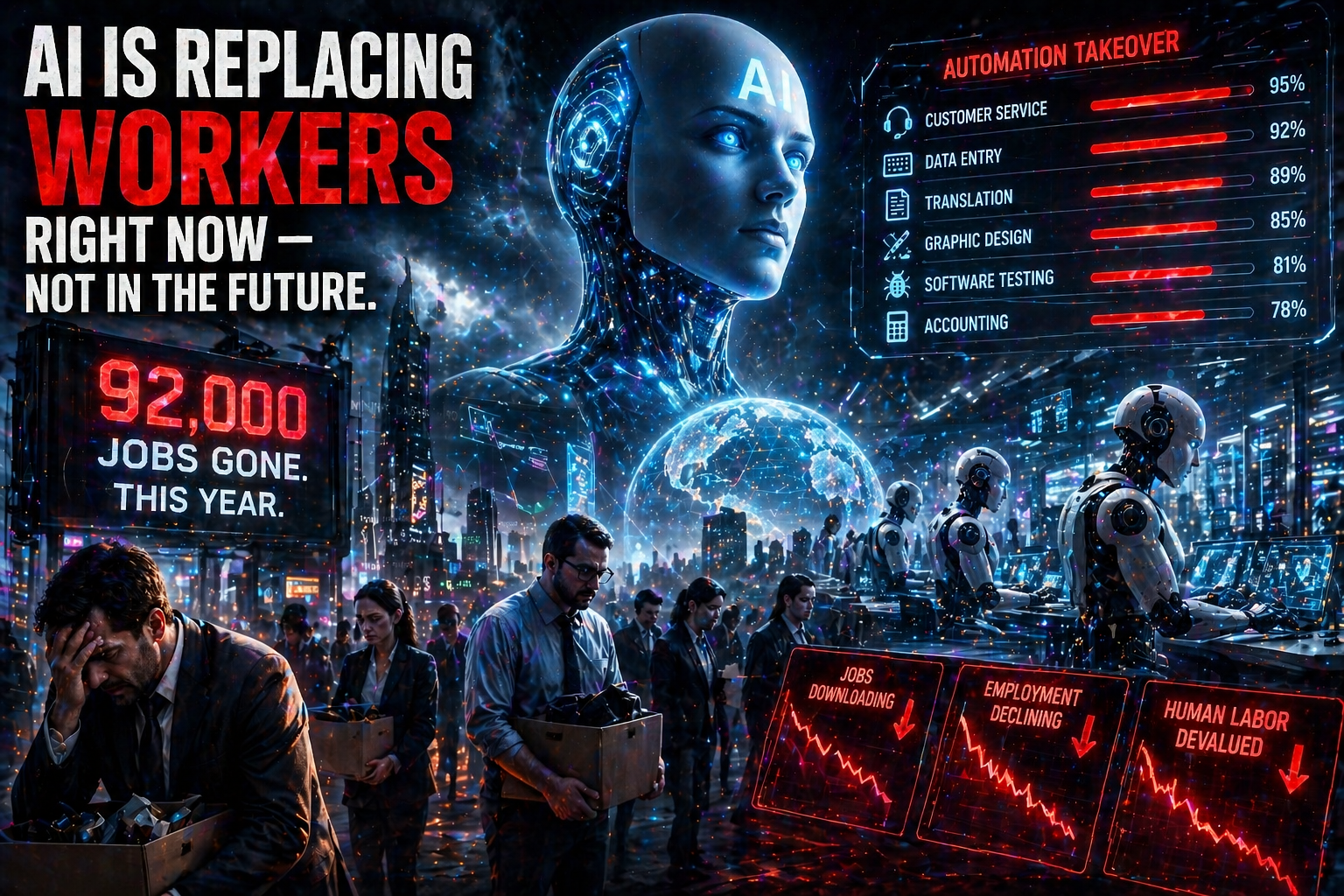
By April 25, 2026, Layoffs.fyi — the most comprehensive tracker of tech industry job losses — confirmed that over 92,000 tech workers had been laid off in 2026 year-to-date. It also noted, quietly, that this brought the total tech job losses since 2020 to nearly 900,000. A number that deserves to be read slowly: nine hundred thousand people, in one industry, in six years.
“This represents a fundamental structural shift rather than a temporary market correction,” said Anthony Tuggle, an executive coach and leadership expert who previously worked with Fortune 500 firms. “The difference this time is that companies are profitable. The cuts are not about survival — they’re about optimization.” That distinction — profitable companies eliminating workers not out of necessity but out of capability — is what makes 2026 historically unprecedented.
The Complete Layoff Map: Who Cut What and Why
Here is the most comprehensive account available of the major AI-influenced workforce reductions of 2026, with the specific AI capabilities cited in each case:
Meta Platforms — 11,000–20,000 Cuts
Announced April 17, 2026. A 10% workforce reduction beginning May 20. Cuts concentrated heavily in the Trust and Safety division, where AI moderation systems have achieved accuracy rates exceeding human moderators across most content categories. Meta also suspended recruitment for approximately 8,000 vacant positions simultaneously — a signal that the reduction is structural, not temporary. The company plans to spend over $135 billion on AI in 2026 alone. The math is brutal: fewer people, more machines, same or better output.
Microsoft — 9,000 Cuts
Announced April 24, 2026. Cuts span Azure cloud operations — where automated infrastructure management has dramatically reduced manual intervention requirements — and customer service divisions where large language models now handle tier-one support at scale. Software testing roles have also been significantly reduced as AI-generated test suites outperform human-written testing in speed, coverage, and bug detection rate. Microsoft simultaneously continues its massive Copilot rollout across its entire product suite.
Amazon — 30,000+ Cuts Since October 2025
The biggest single employer in the cutting wave. Amazon began in October 2025 with what it described as routine restructuring. By January 2026, it announced 16,000 corporate tech role eliminations in one announcement — the largest single-day layoff disclosure in Amazon’s history. The cuts are concentrated in logistics optimization, customer service, and AWS operations, where AI automation has eliminated the need for human judgment in an increasing fraction of routine decisions. Amazon Web Services simultaneously reported record revenue growth.
Oracle — 20,000–30,000 Cuts (March 2026)
Oracle’s March 31, 2026 announcement was notable for its scale and its unusual transparency: the company stated directly that AI-powered database management and cloud operations tools had reduced the human labor required for core infrastructure functions by approximately 40%. CEO Safra Catz framed the cuts as necessary to “reallocate capital toward AI infrastructure” — the clearest admission yet that workforce savings are being directly recycled into AI spending.
Block (Square/Cash App) — 4,000 Cuts (40% of Workforce)
Block’s March 2026 announcement is historically significant: it is the largest single workforce reduction explicitly attributed to AI automation in corporate history. The cuts were concentrated in customer support, where Block’s AI-powered service system demonstrated the ability to resolve 70–80% of customer inquiries without human intervention. Similar AI resolution rates have played out at eBay, Pinterest, and ANGI Homeservices. The customer support role — once considered a stable, human-essential position — appears to have been industrially automated in fintech.
Snap Inc. — 1,000 Cuts + 300 Roles Closed
Announced April 15, 2026. CEO Evan Spiegel’s letter to staff was remarkable for its directness: the cuts were driven by “rapid advancements in artificial intelligence that allow smaller teams to achieve the same output.” Most strikingly, Spiegel disclosed that AI now generates more than 65% of Snap’s new code — meaning more than two-thirds of the company’s engineering output is produced without human hands on a keyboard. The restructuring is expected to deliver over $500 million in annualized cost savings by the second half of 2026.
| Company | Jobs Cut | % of Workforce | AI Role Cited | Timing |
|---|---|---|---|---|
| Amazon | 30,000+ | ~10% | Logistics, AWS, customer service | Oct 2025–Jan 2026 |
| Oracle | 20,000–30,000 | ~15% | Database management, cloud ops | March 2026 |
| Meta | 11,000–20,000 | 10–20% | Content moderation, Trust & Safety | April 2026 |
| Dell Technologies | 11,000 | ~10% | Infrastructure automation | Q1 2026 |
| Microsoft | 9,000 | ~6% | Azure ops, customer service, testing | April 2026 |
| Block (Square) | 4,000 | 40% | Customer support AI resolution | March 2026 |
| Atlassian | 1,600 | 10% | Engineering automation | Q1 2026 |
| Snap | 1,000 | 16% | AI code generation (65% of output) | April 2026 |
| Salesforce | 4,000 | ~8% | Customer support automation | September 2025 |
Why This Is Different From Every Previous Tech Layoff Wave
The tech industry has been here before — or so it appears. The dot-com collapse of 2001. The financial crisis of 2008. The pandemic correction of 2022–2023, when companies that had hired aggressively during COVID reversed course dramatically. Each time, economists described the layoffs as cyclical: painful, but temporary. The workers would return, or new jobs would emerge, or the companies would regret their cuts and rehire within 18 months.
The 2026 AI-driven wave is different in three ways that matter deeply, and understanding those differences is essential for anyone trying to assess their own career risk:
Companies Are Profitable
Every previous major tech layoff wave happened during financial stress. The 2026 cuts are happening at companies posting record revenues and strong margins. Meta’s Q1 2026 earnings were exceptional. Amazon’s cloud revenue is growing 20%+ year-over-year. These are not companies cutting to survive. They are cutting to optimize.
Not cyclical — structural
The Cuts Are Specific
Previous waves hit broadly. These cuts are surgical. Customer support roles. Content moderation. Basic software testing. Infrastructure management. The common denominator: roles where AI has demonstrably matched or exceeded human performance in controlled production environments.
Role-specific, AI-attributed
The Jobs Won’t Come Back
In previous cycles, companies typically rehired within 12–18 months as conditions improved. In 2026, companies are simultaneously cutting headcount AND closing open positions in affected roles. Meta suspended recruitment for 8,000 roles. This signals that the eliminated positions are not expected to return — they have been permanently automated.
Positions closed permanently
The Narrative Has Normalized
Six months ago, explicitly citing AI as the reason for layoffs was a reputational risk. Today, it is the standard framing in corporate press releases. Block, Atlassian, Meta, and Snap have all used AI automation as the primary justification — and faced minimal public backlash compared to what would have occurred even a year ago.
AI attribution now normalized
— Molly Zhao, labor market economist, CNBC, April 24, 2026
The Jobs AI Is Eliminating First — By the Data
Which specific roles are disappearing? The data from 2026 layoff disclosures creates a surprisingly clear picture of AI’s current capability frontier:
🔴 Highest Impact — Already Being Eliminated at Scale
A 2026 Motion Recruitment study confirmed that AI adoption is actively slowing hiring for “entry-level and generalized IT roles,” while AI-specific positions remain in extremely high demand. Tech salaries have remained largely flat from 2025 with one significant exception: AI engineers, who are seeing double-digit salary increases. The market is not eliminating technology careers — it is bifurcating them.
The Hidden Story: Third-Party Workers Nobody Is Counting
The official layoff numbers — as staggering as they are — significantly undercount the actual workforce impact. When Meta eliminates its content moderation team, the loss extends far beyond Meta’s direct employees.
Meta’s content moderation was partly handled by third-party contractors through firms like Cognizant and Accenture, which together employ over 15,000 workers on Meta contracts alone. Both firms have announced their own workforce reviews following Meta’s announcement. These 15,000 workers are not counted in Meta’s layoff figures. They are, effectively, invisible to the headline statistics.
— AI Business Review, April 25, 2026
The same pattern repeats across the industry. When Amazon automates its logistics optimization, the impact flows through a supply chain of third-party logistics coordinators, route planners, and operational support workers — most employed by smaller firms that will never make a headline when they quietly reduce hours or eliminate positions. The true employment impact of the 2026 AI wave is almost certainly two to three times larger than the numbers being publicly reported.
The invisible workers: For every direct tech job eliminated and reported in the layoff data, analysts estimate 2–3 additional jobs are lost in the contractor, outsourcer, and supplier ecosystem that supports those roles. By this multiplier, the true 2026 employment impact could exceed 250,000 jobs — a figure that would make this the largest AI-attributable labor disruption in history.
The $700 Billion Paradox: Cutting Workers While Spending More
There is a number that makes the 2026 AI labor crisis feel paradoxical, and it’s worth sitting with: Alphabet, Microsoft, Meta, and Amazon are expected to spend nearly $700 billion combined on AI infrastructure in 2026. This is the largest single-year technology investment by a group of companies in history. These are not struggling businesses conserving resources. They are organizations at the peak of their financial power — and they are still cutting people.
The explanation is the paradox itself: the more they invest in AI, the more capable AI becomes, the fewer humans they need to hire. The workforce savings from eliminating human roles directly fund the AI infrastructure that eliminates further human roles. It is a self-reinforcing cycle that, once started, has no obvious natural stopping point.
$135B — Meta’s 2026 AI Spend
Meta is spending $135 billion on AI in 2026. The company is simultaneously cutting 10–20% of its workforce. The workforce savings partially fund the AI spending. This is the loop that defines the current moment.
Savings fund automation
280× — AI Cost Drop in 2 Years
The cost of AI inference has dropped 280-fold in two years. An AI task that cost $280 in 2024 costs $1 in 2026. This is why mid-market companies — previously unable to afford enterprise AI — are now beginning their own workforce reductions.
Democratizing displacement
$9B — Agentic AI Market 2026
The agentic AI market — systems that can execute multi-step business processes without human intervention — has grown to $9 billion in 2026. As these systems prove reliable in production, companies will have both capability and justification to reduce human workforces further.
The next wave begins
40% — Business Software AI by End 2026
Gartner predicts that by end of 2026, 40% of business software will include AI capable of completing tasks independently — without human supervision. This includes fraud detection, loan processing, customer onboarding, and supply chain management.
Expanding into every sector
The venture capital signal: VCs say companies that aren’t operating with the ethos of “growing faster with far fewer people” are having a much harder time raising cash. The investor class has effectively mandated AI-driven efficiency as a condition of funding. This means the workforce reduction wave will spread from public tech giants to thousands of VC-backed startups over 2026–2027 — reaching employment sectors far beyond Silicon Valley.
Which Jobs Are Safe? An Honest Risk Assessment
This is the question everyone is asking — and the honest answer is more nuanced than either the optimists or pessimists want to admit. Here is the clearest picture available based on 2026 data:
Customer Support
70-80% AI resolution rate already achieved. Human agents primarily handle escalations only.
85%
Content Moderation
AI accuracy exceeds humans. Meta has already demonstrated industrial-scale displacement.
82%
Junior Software Engineer
AI generates 65%+ of code at leading firms. Entry-level roles disappearing fastest.
68%
Basic Content Creation
Marketing copy, product descriptions, standard articles. AI does this at scale for near-zero cost.
65%
Data Entry / Processing
Routine data tasks are essentially fully automatable with current AI. The question is implementation speed.
72%
Mid-Level Engineers
AI assists significantly but complex system design and architectural decisions remain human-driven.
38%
Financial Analysts
AI handles data aggregation and standard reports. Complex judgment, client relationships remain human.
35%
AI Engineers / Researchers
Demand up 67% YoY. Building, maintaining and improving AI systems requires deep human expertise.
12%
Physical Trades
Electricians, plumbers, surgeons, physical therapists. AI cannot yet operate physical reality reliably.
8%
The pattern that protects jobs: The roles with the lowest risk share common traits — they require physical presence, genuine relationship management, complex novel judgment, creative direction (not execution), or deep domain expertise that makes AI outputs difficult to verify without human knowledge. The safest careers in 2026 are those where you can evaluate AI’s work, not just produce it.
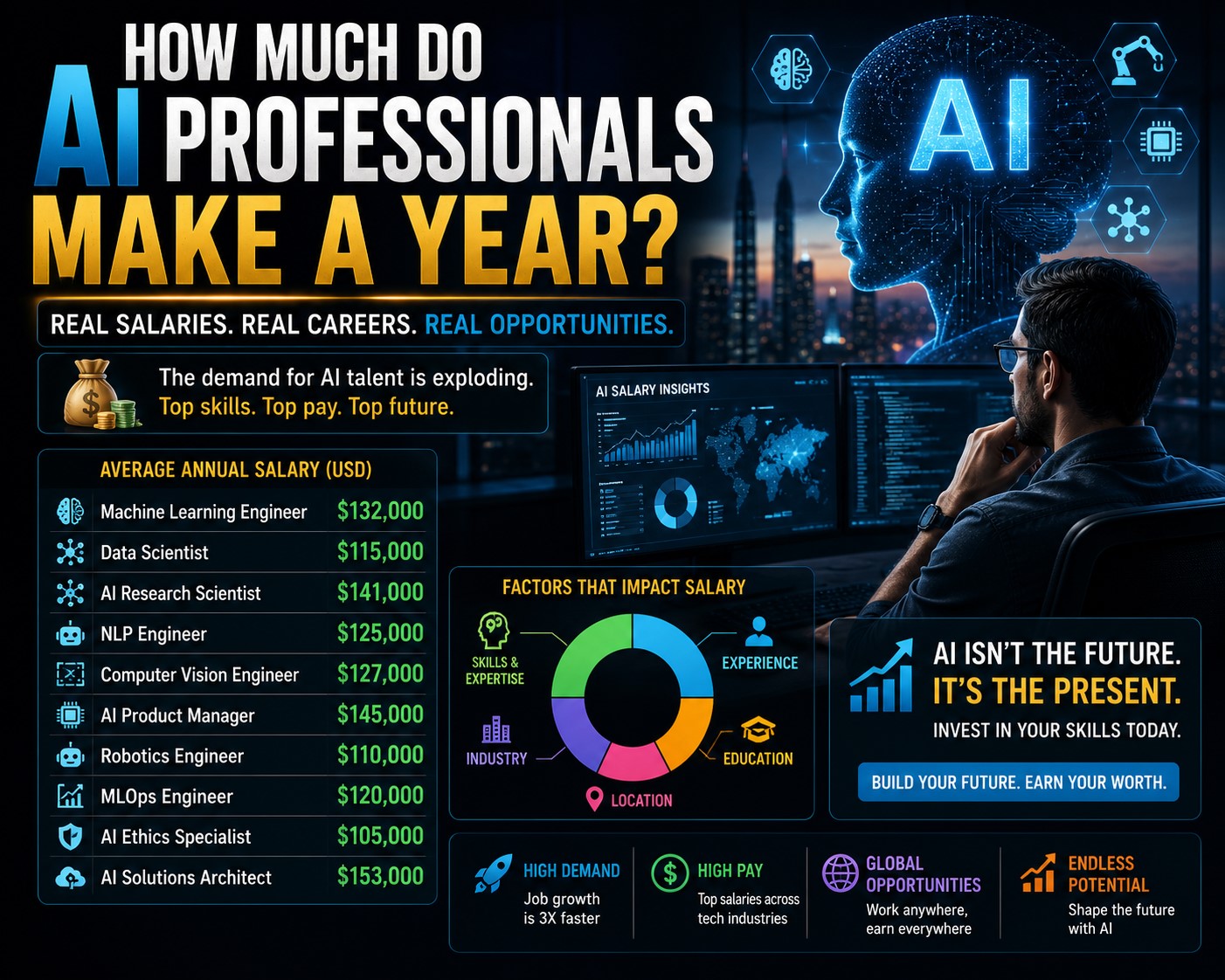
Who’s Being Hired? The New AI Job Market
The layoff story is real — but it coexists with one of the most aggressive hiring waves in technology history, concentrated in a narrow band of AI-specific roles:
AI Engineers & Researchers
Demand up 67% year-over-year. Salaries at frontier labs start at $300K+. Companies are competing globally for a small talent pool that simply cannot be expanded quickly.
+67% demand YoY
AI Product Managers
Every major company needs PMs who can bridge technical AI capabilities and business use cases. Demand is growing faster than the talent supply in virtually every sector.
High demand, scarce supply
AI Safety & Ethics Roles
Regulatory pressure from the EU AI Act and growing US scrutiny is creating genuine demand for AI governance, ethics, and safety roles — a category that barely existed 3 years ago.
Regulatory-driven growth
AI Data Curators
Training AI models requires high-quality, labeled, verified data. Human judgment in data curation remains essential — and companies are hiring at scale for workers who can generate and verify training datasets.
Counterintuitive demand
AI Implementation Consultants
Every business wants to deploy AI but most lack the expertise to do it. Consultants who can plan, execute, and measure enterprise AI deployments are among the most in-demand professionals of 2026.
Explosive demand
AI Trainers / Prompt Engineers
Teaching people how to effectively use AI systems has become a legitimate career. Corporate AI training programs, prompt engineering, and AI workflow design are now billable professional services.
New career category
The Human Stories Behind the Numbers
Numbers are important. But numbers can make it too easy to abstract away what is actually happening to individual people whose lives are being restructured by forces they did not choose and cannot easily counter. Three patterns keep appearing in the testimony of laid-off workers:
— Anonymous laid-off worker, Reddit /r/layoffs, April 2026
— Former Oracle operations analyst, LinkedIn post, March 2026
— Former Microsoft Azure support lead, interview with The Atlantic, April 2026
These stories point to something the aggregate data cannot capture: the psychological and social difficulty of navigating a labor market transformation that has no historical parallel. Previous job displacement — from agriculture to industry, from industry to services — occurred over decades. The AI displacement of 2026 is occurring in quarters. The human capacity to adapt is being tested at a pace it has not encountered before.
What Experts Are Saying — And Where They Disagree
The Pessimists
Goldman Sachs economists warn that AI could expose 300 million jobs globally to automation. MIT labor economist David Autor argues that unlike previous technological transitions, AI is targeting cognitive and service work — the sectors that absorbed workers displaced from manufacturing. There is no obvious “next sector” to absorb them.
300M jobs at risk globally
The Optimists
Investor Marc Andreessen calls AI an “80-year overnight success” and argues the productivity gains will generate new categories of work. Rajat Bhageria (Chef Robotics CEO) says AI will create jobs — “it’s just less certain what that will look like at the moment.” Historical precedent: the printing press, electricity, and computers all expanded employment long-term.
Historical precedent favors recovery
The Realists
The emerging consensus: AI will not eliminate work entirely, but it will bifurcate the labor market sharply between those who can work with AI and those who cannot. The transition will be painful, uneven, and likely require significant policy intervention. The speed of the current disruption is unprecedented and may overwhelm traditional adaptation mechanisms.
Bifurcation, not elimination
The Policymakers
The EU AI Act is already in force, requiring impact assessments for high-risk AI deployments. Multiple US states are considering AI-driven layoff notification laws. South Korea has proposed mandatory retraining funds for AI-displaced workers. The regulatory response is beginning, but lagging the disruption by years.
Policy response just beginning
Where experts actually agree: Almost no serious economist or technologist believes the next 5 years will be comfortable for workers in routine cognitive roles. The disagreement is about the 10–20 year horizon: whether AI creates enough new work to compensate for what it destroys, and whether the transition can be managed without severe social disruption. On the short-term, the data is already delivering the verdict.
The Timeline: How We Got Here So Fast
ChatGPT Launches — The Public Wakes Up
100 million users in 60 days. The world discovers AI can do things previously considered uniquely human. Companies begin quietly evaluating which workflows could be automated.
The Evaluation Phase
Enterprises run pilots. AI proves itself in controlled environments. Companies begin making internal decisions about headcount, but cuts remain modest and rarely attributed publicly to AI. 240,000 tech jobs cut industry-wide — mostly framed as “correction” from pandemic overhiring.
The Deployment Phase
AI moves from pilot to production at scale. Salesforce cuts 4,000 customer support roles in September, Marc Benioff says “I need less heads.” AI inference costs drop 10×. The economic case for replacement hardens.
Amazon’s January Shock
16,000 corporate tech roles eliminated in a single announcement. The largest single-day layoff disclosure in Amazon history. The media notes it. Markets shrug. Amazon stock rises.
Block’s Historic Precedent
Block announces the largest workforce reduction explicitly attributed to AI automation in corporate history — 4,000 workers, 40% of the company. The customer support sector effectively announces it is now an AI-operated industry.
Snap’s Disclosure Changes Everything
CEO Spiegel discloses that AI generates 65% of Snap’s new code. This is the first major public company to quantify AI’s share of its engineering output. The implications are immediate and industry-wide.
The Week of Reckoning
Meta and Microsoft announce 20,000+ combined cuts on the same day. Media coverage reaches saturation. CNBC, Reuters, The Verge, and every major outlet cover the story as a turning point. 92,000 tech jobs lost year-to-date is confirmed by Layoffs.fyi.
The Wave Spreads
Analysts project the AI-driven optimization wave now spreading from mega-cap tech to mid-market companies across finance, healthcare administration, legal services, and logistics. The 280× cost reduction in AI inference makes automation economically viable at smaller scales than ever before.
What Should You Do Right Now? A Practical Guide
This is the section most readers came for, so we’ll be direct: there is no single answer that applies to everyone, and anyone who tells you otherwise is either naive or selling something. But there are principles that the 2026 evidence consistently supports:
Learn to Work With AI, Not Against It
The clearest predictor of job safety in 2026 is whether you can effectively direct, evaluate, and improve AI outputs. The workers most at risk are those who do tasks that AI now does autonomously. The workers most in demand are those who make AI do tasks better.
Most actionable advice
Specialize, Don’t Generalize
Generalist roles are at highest risk. Domain-specific expertise — combined with AI fluency — creates defensible professional value. A generalist content writer is highly vulnerable. A content strategist who specializes in regulated industries and uses AI as a tool is significantly more protected.
Niche + AI = resilience
Build Relationships, Not Just Skills
AI cannot replicate trust, institutional knowledge, or genuine relationships with clients, colleagues, and stakeholders. The workers who are hardest to replace are those who are embedded in human systems that AI cannot access — not just those with skills AI cannot replicate.
Social capital matters
Continuous Learning Is No Longer Optional
The half-life of professional skills is compressing faster than any previous period in history. Investing in learning — specifically in AI tools relevant to your field — is not a nice-to-have. It is now a basic requirement of career maintenance.
Commit to quarterly skill updates
Consider High-Difficulty Physical Roles
Electricians, plumbers, healthcare workers, and tradespeople are among the most insulated from current AI displacement. If you’re early in your career and looking for resilience over prestige, the trades have never been a better investment.
Physical work is surprisingly safe
Document Your Irreplaceable Value
If you find yourself asking “could AI do this?” about your own job — the time to act is before your employer asks the same question. Reframe your role around judgment, relationships, and oversight rather than execution. Make your value visible and unmistakably human.
Proactive, not reactive
FAQ: Your AI Job Crisis Questions Answered
📚 Primary Sources & References
- CNBC — 20K Job Cuts at Meta, Microsoft Raise Concern of AI Labor Crisis — April 24, 2026
- Tech Insider — Tech Layoffs 2026: How AI Is Driving the Biggest Workforce Restructuring — April 2026
- AI Business Review — Meta & Microsoft: 20K Cuts as AI Replaces Workers
- Layoffs.fyi — Tech Layoff Tracker 2026 — Real-time job loss data
- Medium — AI Daily Update April 25, 2026 — Meta, Microsoft, DeepSeek V4, SpaceX AI
- MarketingProfs — AI Update April 24, 2026 — GPT-5.5, OpenAI workspace agents
- MIT Technology Review — 10 Things That Matter in AI Right Now (2026)
- BuildEZ — AI Trending April 2026: The Top 5 Developments — Agentic AI market data
- Workers Rights — Meta & Snap Layoffs 2026: AI Behind Tech Job Cuts
📊 Stay Ahead of the AI Disruption
The AI labor market is changing every week. Subscribe free for our weekly analysis of which jobs are safe, which are at risk, and how to position yourself for the economy that’s being built right now.