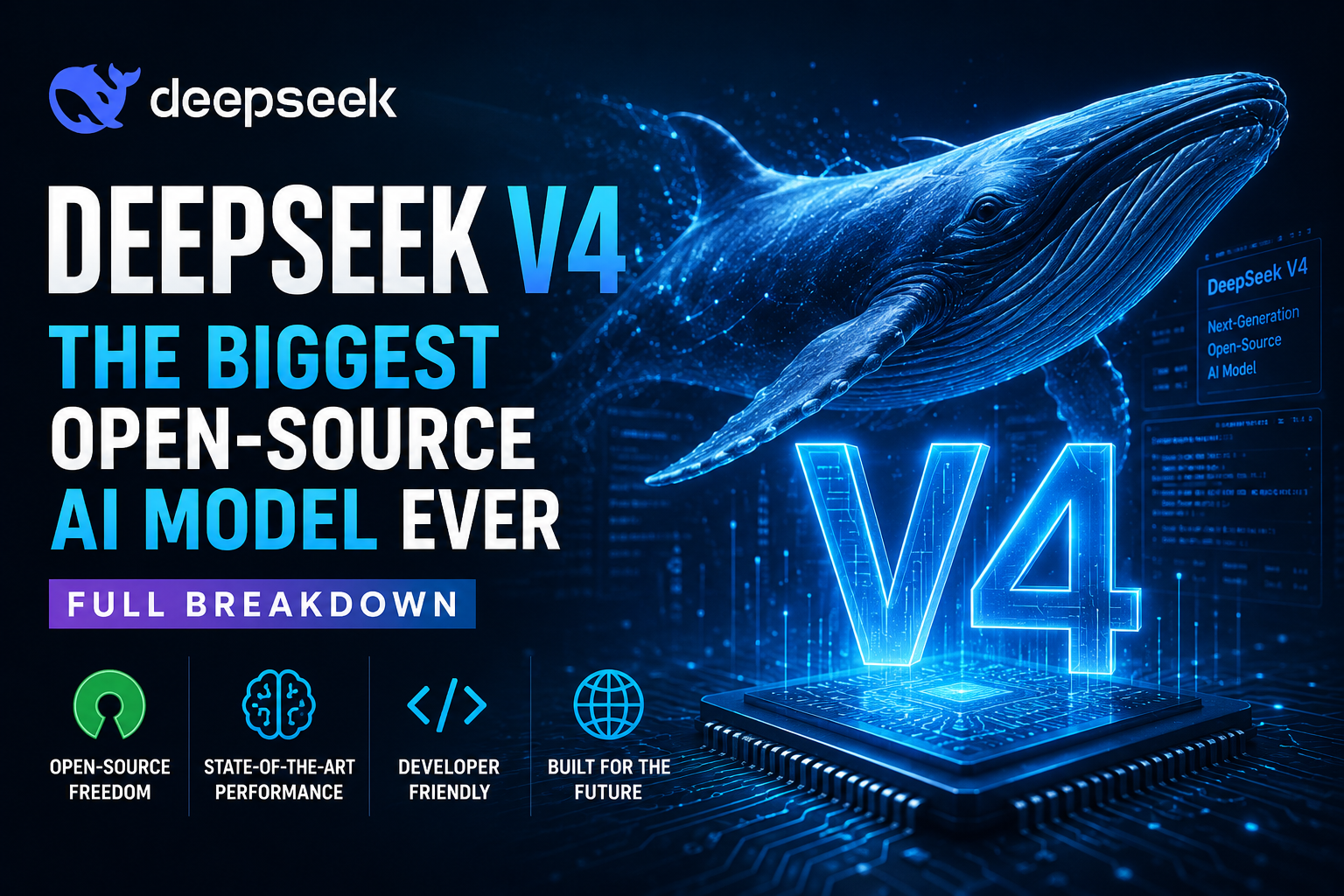
AI Model Ever — Full Breakdown (2026)
A year after R1 shocked Silicon Valley, DeepSeek is back with something even bigger. 1.6 trillion parameters. 1M token context. 7× cheaper than Claude Opus. Built on Chinese chips. Here is everything you need to know.
V4-Pro
Window
Score
Claude Opus
Open Weights
Weight Model
DeepSeek Strikes Again — And V4 Changes Everything
On April 24, 2026, Chinese AI lab DeepSeek published two new models to Hugging Face under the MIT License — simultaneously announcing them as production-ready through their API. The models: DeepSeek-V4-Pro and DeepSeek-V4-Flash. Within hours, every major AI publication from TechCrunch to Bloomberg was covering the story. This was the hotly anticipated release that had missed three launch windows over four months. The wait was worth it.
DeepSeek V4-Pro is now the largest open-weight model ever publicly released — surpassing Kimi K2.6 (1.1 trillion parameters), GLM-5.1 (754 billion), and more than doubling DeepSeek’s own V3.2 (685 billion). The Pro model weighs 865GB on Hugging Face. Flash weighs 160GB.
Most importantly: the benchmarks are real. V4-Pro scores 80.6% on SWE-bench Verified — within 0.2 percentage points of Anthropic’s Claude Opus 4.6, which costs $25 per million output tokens. V4-Pro costs $3.48 per million output tokens. That is a 7× price gap at near-identical coding performance. For developers and teams running high-volume API workloads, this math is impossible to ignore.
The headline fact: DeepSeek V4-Pro was trained entirely on Huawei Ascend 950 chips and Cambricon accelerators — zero Nvidia hardware. This is the first frontier-class model to prove that Washington’s semiconductor export control strategy has a significant gap. Chinese AI can now train at the frontier using domestic chips. The geopolitical implications extend far beyond any benchmark table.
“This makes DeepSeek-V4-Pro the new largest open weights model — bigger than Kimi K2.6, GLM-5.1, and more than twice the size of DeepSeek V3.2. What’s really notable here is the cost.”
— Simon Willison, prominent AI developer, simonwillison.net
V4-Pro vs V4-Flash — Complete Specifications
DeepSeek released two models simultaneously — not just a large/small split, but a fundamental product segmentation between maximum capability and cost-optimized speed. Both support a full 1 million token context window and MIT license.
49B Active/Token
MIT License
13B Active/Token
MIT License
Critical note from official model cards: This release does NOT include a Jinja-format chat template. DeepSeek provides Python encoding scripts (encoding_dsv4.py) in the model repository for prompt construction. Plan for this in your integration. The recommended sampling parameters for local deployment are temperature = 1.0, top_p = 1.0.
Three Architecture Breakthroughs That Make V4 Possible
DeepSeek V4 is not simply a scaled-up V3. Three specific architectural innovations — all published in peer-reviewed papers before the launch — directly address the engineering challenges of building a 1.6 trillion parameter model with a genuinely usable 1M token context window.
Hybrid Attention: CSA + HCA
The most consequential change. DeepSeek V4 replaces standard full attention with a hybrid of Compressed Sparse Attention (CSA) and Heavily Compressed Attention (HCA). CSA applies token-wise compression to key-value pairs for moderately distant context. HCA applies aggressive compression to very distant tokens, storing compact summary representations. At the full 1M token context length, V4-Pro uses only 27% of the single-token inference FLOPs and requires only 10% of the KV cache memory compared to V3.2. This is what makes million-token context economically viable in production — not just a marketing claim.
Manifold-Constrained Hyper-Connections (mHC)
Training a 1.6 trillion parameter MoE model is notoriously unstable. DeepSeek introduced mHC to strengthen conventional residual connections, enhancing stability of signal propagation across layers while preserving model expressivity. mHC constrains the residual connections to lie on a learned manifold, preventing the gradient instability that typically plagues very deep expert networks at this parameter scale. The practical effect: more stable training curves and better final benchmark performance than comparable models trained without mHC.
Muon Optimizer for Faster Convergence
V4 was trained using the Muon optimizer — a second-order-inspired optimization method that achieves faster convergence than standard AdamW on large-scale transformer training. The Muon optimizer allowed DeepSeek to reach the same level of training quality with fewer compute cycles, partially explaining how frontier-level performance was achieved on domestic Huawei Ascend chips rather than Nvidia’s H100/H200 cluster hardware. Pre-training on over 32–33 trillion tokens gives both V4-Pro and Flash the knowledge base to compete with proprietary frontier models on general knowledge tasks.
On the hardware: DeepSeek V4 was trained entirely on Huawei Ascend 950 chips and Cambricon accelerators — unlike R1 which used Nvidia hardware. Huawei’s “Supernode” technology provided the interconnect fabric for the training cluster. Additionally, DeepSeek reportedly prioritized early optimization access to domestic chipmakers before giving it to Nvidia and AMD. This was a deliberate geopolitical statement, not just a technical decision.
DeepSeek V4 Benchmarks vs Every Frontier Model
DeepSeek published extensive benchmark data on release. Independent researchers at Artificial Analysis and BuildFastWithAI verified these numbers within 24 hours of launch. Here is the honest, complete picture — wins and losses.
| Benchmark | DeepSeek V4-Pro | Claude Opus 4.6 | GPT-5.4 | Gemini 3.1 Pro | Winner |
|---|---|---|---|---|---|
| SWE-bench Verified | 80.6% | 80.8% | ~81% | ~79% | Δ 0.2pts gap |
| Codeforces Rating | 3,206 | ~2,900 | 3,168 | ~2,800 | V4-Pro #1 |
| LiveCodeBench | 93.5% | 88.8% | ~90% | ~89% | V4-Pro #1 |
| Terminal-Bench 2.0 | 67.9% | 65.4% | ~66% | ~64% | V4-Pro #1 |
| HMMT 2026 (Math) | 95.2% | 96.2% | 97.7% | ~97% | V4 3rd Place |
| HLE (Hard Reasoning) | 37.7% | 40.0% | 39.8% | 44.4% | V4 4th Place |
| SimpleQA (Knowledge) | 57.9% | ~62% | ~65% | 75.6% | Gemini leads |
| API Output Price | $3.48/M | $25.00/M | ~$15.00/M | ~$10.00/M | V4-Pro 7x cheaper |
| AI Intelligence Index | 52 / 100 | ~55 | ~58 | ~60 | V4 above average |
The honest benchmark summary: V4-Pro leads all models globally on coding tasks — Codeforces, LiveCodeBench, Terminal-Bench — while coming within 0.2 points on SWE-bench. It trails GPT-5.4, Claude, and Gemini on hard reasoning (HLE) and general knowledge (SimpleQA). DeepSeek itself estimates it trails state-of-the-art frontier models by approximately 3–6 months of development on these dimensions. For coding and agentic workloads specifically, however, V4-Pro is the global leader — open or closed.
DeepSeek V4 Pricing vs Every Major Competitor
The pricing is where V4 delivers its most decisive competitive advantage. Both V4-Pro and V4-Flash are the cheapest models in their capability tier — not by a small margin, but by a factor of 7x or more.
The $100M math: A company running a coding agent that processes 100 million output tokens per month spends $2,500/month with DeepSeek V4-Pro versus $25,000/month with Claude Opus 4.6 — at near-identical SWE-bench performance. The $22,500/month saving funds three full-time engineers. At a billion tokens per month, the gap is $228,000/month. This is why V4’s pricing announcement triggered immediate architectural re-evaluation across the AI industry.
For teams not wanting to access DeepSeek’s native API directly (due to data privacy or reliability concerns), both V4-Pro and V4-Flash are available through OpenRouter at similar pricing. OpenRouter acts as a proxy, routing requests to multiple provider endpoints and supporting fallback logic. The OpenRouter pricing for V4-Pro is approximately $0.435 per million input tokens and $0.87 per million output tokens — slightly higher than native DeepSeek API pricing but with added reliability infrastructure.
The DeepSeek Story — From R1 to V4
Who Should Use DeepSeek V4 — And Who Shouldn’t
Based on the benchmark profile and pricing math, here is the honest breakdown of who DeepSeek V4 is right for in 2026.
Coding Agent Developers
Processing high token volumes for SWE-bench class tasks. 7x cost savings at comparable benchmark performance makes V4-Pro the immediate default.
Startups on Budget
Building AI applications where API cost determines unit economics. V4-Flash at $0.28/M output is essentially free at most startup scales.
Long-Document Processing
Legal, scientific, or enterprise workflows requiring entire codebases or large documents in a single context. 1M tokens eliminates chunking entirely.
Open-Source Projects
MIT license means V4 can be fine-tuned, modified, and deployed commercially without restrictions or royalties. Download the weights, run locally.
Multimodal Workflows
Both V4 models are text-only at launch. No image, audio, or video input. Users needing multimodal capabilities must continue with GPT-5.4, Gemini, or Claude.
World Knowledge Tasks
SimpleQA at 57.9% versus Gemini’s 75.6% reveals a meaningful factual knowledge gap. Research applications needing accurate real-world fact retrieval should prefer Gemini.
High-Volume Batch Processing
Document summarization, analytics pipelines, data extraction at scale — V4-Flash at $0.28/M output eliminates API cost as a limiting factor for most workloads.
Enterprise Safety-Critical
Deployments requiring Anthropic/OpenAI Constitutional AI safety frameworks, GDPR-compliant data handling, and US-jurisdiction data residency should stay with closed-source providers.
“For new projects: Start with deepseek-v4-flash. Upgrade to Pro only if benchmarks reveal a quality gap on your specific task. For existing V3.2 users: Migrate now. The API is compatible, and the improvements in long-context efficiency pay for themselves at volume.”
— Codersera Engineering Team, DeepSeek V4 Review (April 2026)
Huawei Chips, Export Controls & The AI Sovereignty Play
The most consequential detail buried inside the V4 release is not the benchmark score or the pricing — it is the hardware. DeepSeek V4 was built and runs on Huawei Ascend 950 chips and Cambricon accelerators. This directly challenges the premise of Washington’s two-year campaign restricting China’s access to advanced Nvidia silicon.
The theory behind export controls was clear: limit China’s access to the H100, H200, and A100 chips, and you limit their AI training capability. DeepSeek V4 is empirical evidence against that theory at the frontier scale. A 1.6 trillion parameter model trained on domestic chips and reaching near-frontier benchmark performance on coding tasks is a geopolitical statement, not just a technical achievement.
Chinese AI App Stocks Drop
Minimax (100 HK) fell 9.4% and Knowledge Atlas (2513 HK) dropped 9.1% on the day of release — V4 is seen as commoditizing the domestic Chinese AI app layer further.
Chinese Chipmakers Surge
HHS (1347 HK) spiked +15.2% and SMIC (981 HK) gained +10% — Huawei’s Ascend ecosystem just received the biggest real-world endorsement in its history.
Silicon Valley: Cautious Relief
V4-Pro trails GPT-5.4 and Gemini 3.1 Pro by 3–6 months in overall capability. Bloomberg’s headline: “DeepSeek’s new model fails to narrow US lead in AI.” US tech markets were largely unmoved.
Developers: Ecstatic
On Hugging Face and X, developers celebrated immediately. OpenRouter added both models within hours of launch. The open-source community gained its most powerful foundation model ever.
“It allows AI systems to be built and deployed without relying solely on Nvidia — V4 could ultimately have an even bigger impact than R1, accelerating adoption domestically and contributing to faster global AI development overall.”
— Wei Sun, Principal AI Analyst, Counterpoint Research (via CNBC)
Notably, on the same day V4 launched, the White House published a memo from Science & Technology Director Michael Kratsios accusing foreign entities of conducting “industrial-scale” campaigns to distill frontier AI models from US companies. OpenAI and Anthropic have both formally accused DeepSeek of distillation — copying capabilities from their models into smaller, cheaper open-source versions. The timing was not coincidental.
How to Use DeepSeek V4 API Today — Quick Start
DeepSeek V4-Pro and V4-Flash are available immediately through three access routes. The API is OpenAI-compatible, meaning minimal code changes for teams already using OpenAI or Anthropic SDKs.
⚙ Three Ways to Access DeepSeek V4
- DeepSeek Native API — chat.deepseek.com, api.deepseek.com — Lowest price, first-party endpoint, $1.74/$3.48 per million tokens for Pro
- OpenRouter — openrouter.ai/deepseek/deepseek-v4-pro — Higher reliability via multi-provider routing, $0.435/$0.87 per million tokens
- Self-hosting via Hugging Face weights — 865GB for Pro, 160GB for Flash — Full control, no per-token cost beyond infrastructure
Critical integration note: This release does NOT include a Jinja-format chat template — unlike most models. You must use the Python encoding scripts provided in the DeepSeek-V4-Pro repository on Hugging Face (encoding_dsv4.py) for prompt construction. For the Think Max (xHigh) reasoning mode, set context window to at least 384K tokens and sampling parameters to temperature=1.0, top_p=1.0. Plan for 1.81s time-to-first-token on the native API.
Three Reasoning Modes
- Low (Standard): Fastest response, minimal reasoning tokens. Best for high-volume production tasks where speed and cost dominate
- High (Thinking): Extended chain-of-thought reasoning. Best for complex coding, analysis, and multi-step problem solving
- xHigh (Think Max / Expert Mode): Maximum reasoning effort. Maps to Pro-Max variant. Use for the hardest tasks where quality trumps cost and speed. Note: the model is “very verbose” at this setting — 190M average tokens on intelligence index evaluation
DeepSeek V4 — Every Question Answered
What is DeepSeek V4 and when was it released?
DeepSeek V4 is a family of two large language models — V4-Pro and V4-Flash — released by Chinese AI startup DeepSeek on April 24, 2026. Both are open-weight models published on Hugging Face under the MIT License, available through the DeepSeek API and OpenRouter. V4-Pro is the flagship with 1.6 trillion total parameters (49B activated per token). V4-Flash is the efficiency variant with 284 billion total parameters (13B activated). Both support a 1 million token context window.
Is DeepSeek V4-Pro the largest open-source AI model ever released?
Yes, as of April 2026. DeepSeek V4-Pro with 1.6 trillion total parameters is the largest open-weight model ever publicly released. It surpasses Kimi K2.6 (1.1 trillion parameters), GLM-5.1 (754 billion parameters), and more than doubles DeepSeek’s own V3.2 (685 billion parameters). The Pro model weighs 865GB as published on Hugging Face.
How does DeepSeek V4 compare to GPT-5 and Claude?
DeepSeek V4-Pro leads all competitors on coding benchmarks: Codeforces rating 3,206 (best ever by any model), LiveCodeBench 93.5% (#1), Terminal-Bench 2.0 67.9% (#1). It scores 80.6% on SWE-bench Verified — within 0.2 points of Claude Opus 4.6’s 80.8%. However, it trails GPT-5.4, Claude, and Gemini on hard reasoning (HLE at 37.7% vs Gemini’s 44.4%) and factual knowledge (SimpleQA 57.9% vs Gemini’s 75.6%). DeepSeek estimates this gap represents 3–6 months of development time behind the frontier.
How much does the DeepSeek V4 API cost?
DeepSeek V4-Pro via the native DeepSeek API costs $1.74 per million input tokens and $3.48 per million output tokens. DeepSeek V4-Flash costs $0.14 per million input tokens and $0.28 per million output tokens. For comparison, Claude Opus 4.6 costs $25 per million output tokens — making V4-Pro approximately 7x cheaper at near-identical SWE-bench coding performance. Via OpenRouter, V4-Pro is priced at $0.435/$0.87 per million tokens.
What is the CSA and HCA architecture in DeepSeek V4?
CSA (Compressed Sparse Attention) and HCA (Heavily Compressed Attention) are two complementary attention mechanisms that replace standard full attention in DeepSeek V4. CSA applies token-wise compression to key-value pairs for moderately distant context. HCA applies aggressive compression to very distant tokens using compact summary representations. Together, they allow V4-Pro to process 1 million tokens using only 27% of the single-token inference FLOPs and 10% of the KV cache compared to V3.2 at the same context length — making million-token context economically viable in production.
Was DeepSeek V4 really trained on Huawei chips without Nvidia?
Yes. According to DeepSeek’s official release and reporting from Bloomberg and Reuters, DeepSeek V4 was trained entirely on Huawei Ascend 950 chips and Cambricon accelerators — without Nvidia hardware. This contrasts with DeepSeek R1, which was trained on restricted Nvidia chips. Huawei’s Supernode technology provided the interconnect fabric. This is the first confirmed frontier-class model trained exclusively on Chinese domestic AI chips, with significant geopolitical implications for US semiconductor export control effectiveness.
Can DeepSeek V4 Flash run locally on a MacBook?
Possibly, on high-end Apple Silicon MacBooks. DeepSeek V4-Flash weighs 160GB on Hugging Face. A 128GB M5 MacBook Pro may be able to run it with quantization, particularly if only active experts need to be loaded from disk at inference time (the model activates only 13B parameters per token despite 284B total). Quantized versions from the Unsloth team are expected soon. The 865GB V4-Pro model would require cluster-scale hardware to serve at competitive latency.
Does DeepSeek V4 support images, audio, or video?
No. Both V4-Pro and V4-Flash are text-only models at launch. They do not support multimodal inputs or outputs including images, audio, or video. This is one of the key areas where DeepSeek V4 trails closed-source frontier models like GPT-5.4 and Gemini 3.1 Pro, both of which support native multimodal processing. DeepSeek has not announced a timeline for multimodal V4 variants.
The Bottom Line on DeepSeek V4
DeepSeek V4 is not the industry-reshaping shock that R1 was in January 2025. It does not reveal an unexpected leap that rewrites the rules overnight. But in some ways, it is more strategically significant than R1. Because V4 proves that Chinese AI competitiveness is not a fluke. It is systematic, sustained, and accelerating.
A year after R1, DeepSeek has produced the world’s largest open-source model, trained it on domestic hardware, priced it at a fraction of Western alternatives, and made it outperform every closed-source frontier model on the specific benchmark that matters most to developers: real-world software engineering. At 7x lower cost.
For developers evaluating AI tools today: if your workload is coding, agentic tasks, or high-volume document processing, V4 is the most cost-effective choice in the world right now. Start with Flash. Upgrade to Pro only when benchmarks on your specific task reveal a meaningful gap. For teams already on V3.2: migrate now. The API is compatible and the efficiency improvements at 1M context pay for themselves immediately.
The Stanford AI Index 2026 recently concluded that Chinese AI companies have “effectively closed” the performance gap with US rivals. DeepSeek V4 is exhibit A. The AI race is not over. If anything, it is just getting more interesting.