BREAKING: OpenAI releases GPT-5.5 · April 23, 2026 · The Super App era begins
GPT-5.5 Just Landed
And OpenAI Is Building
The Last App You’ll Ever Need
It codes entire projects. It does your research. It operates software on your behalf.
And now OpenAI says it wants to merge all of this into one single platform
that replaces every other app on your computer. Here’s the complete story.
What Is GPT-5.5? The Basics You Need to Know
GPT-5.5 is OpenAI’s newest and most capable AI model, released on April 23, 2026. Despite the name suggesting a modest incremental update, the model represents what OpenAI’s chief scientist Jakub Pachocki called a significant step, with significant near-term improvements expected. It is not a replacement for GPT-5.4 — it sits above it in OpenAI’s lineup, at a higher price point, targeted at the most demanding professional and enterprise use cases.
The simplest description of what makes GPT-5.5 different from its predecessors comes directly from OpenAI’s own announcement: the model “understands what you’re trying to do faster and can carry more of the work itself.” Instead of carefully managing every step, users can give GPT-5.5 “a messy, multi-part task and trust it to plan, use tools, check its work, navigate through ambiguity, and keep going.”
That distinction — between an AI that answers questions and an AI that gets things done — is the central theme of this release. GPT-5.5 is designed to be an agent, not an assistant. The difference is roughly the distinction between having a very smart colleague who answers your questions, and having a very smart colleague who takes ownership of your projects.
— Greg Brockman, Co-Founder and President, OpenAI — Press briefing, April 23, 2026
Same Latency, More Intelligence
GPT-5.5 matches GPT-5.4’s per-token latency in real-world serving while performing at a higher intelligence level. More capable, not slower — a technically difficult achievement that OpenAI specifically highlighted.
No speed tradeoff
Token Efficiency
GPT-5.5 uses significantly fewer tokens to complete the same Codex tasks as 5.4. In practical terms: you get more done per dollar. OpenAI priced it higher than 5.4 but claims the efficiency gains offset the cost for most enterprise users.
More output per dollar
Ambiguity Navigation
Unlike previous models that stalled or hallucinated when facing unclear instructions, GPT-5.5 is specifically trained to navigate ambiguity — making judgment calls about what to do when instructions are incomplete or contradictory.
Critical for real workflows
Self-Verification
GPT-5.5 checks its own work before presenting it. This built-in verification loop reduces error rates on complex tasks — particularly important in coding and scientific research where small errors cascade into large failures.
Built-in quality control
The Super App Vision: What OpenAI Is Actually Building
The most important thing about GPT-5.5’s launch isn’t what the model can do today. It’s what it reveals about where OpenAI is going. And where OpenAI is going is somewhere no Western technology company has successfully arrived before: the “super app.”
The concept comes from Asia, where applications like WeChat in China and Grab in Southeast Asia function as single platforms that handle communication, payments, shopping, food delivery, travel booking, and more — all within one interface. Western tech has never successfully built this. Facebook tried. Amazon tried. Google tried. All failed to break users out of their app-switching habits.
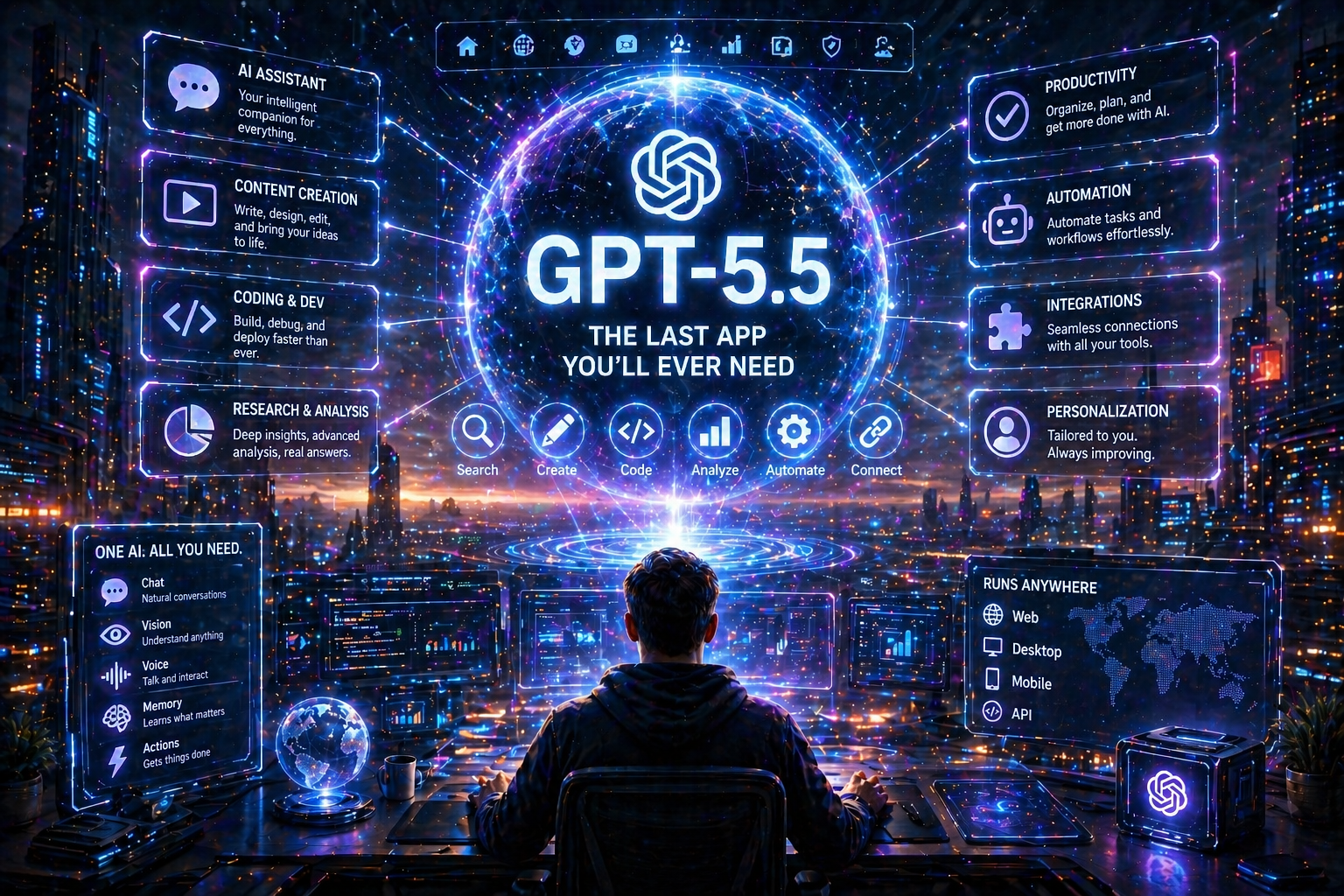
OpenAI believes AI changes the equation. The company seeks to combine the conversational power of ChatGPT with the technical muscle of Codex and the possibilities of the dedicated Atlas AI browser in a unified platform — a “Swiss Army knife” that becomes the hub for all AI-powered needs, from writing code to managing enterprise workflows.
🧩 The OpenAI Super App Architecture
ChatGPT
Conversation, writing, research, knowledge work
Codex
Autonomous software development and debugging
Atlas Browser
AI-powered web browsing, research, and automation
Data Analysis
Spreadsheets, databases, scientific workflows
Computer Use
Operating any software on your desktop autonomously
The strategic logic is compelling. The concept is simple: if ChatGPT excels in areas like writing, coding, research, shopping, scheduling, and customer service, users may stop using other apps. Every time a user stays within the OpenAI ecosystem to complete a task they previously needed five different apps for, OpenAI extends its monetization surface, its data advantage, and its switching cost moat simultaneously.
— Explosion.com Analysis, April 2026
Why this time might be different: Previous “super app” attempts failed because they tried to replicate functionality without reducing friction. AI removes friction at the interface layer — instead of navigating menus, tabs, and separate applications, users describe what they want in natural language and the AI handles the rest. That’s a fundamentally different approach to the problem, and GPT-5.5 is the first model capable enough to actually deliver it across a meaningful range of professional tasks.
What GPT-5.5 Can Actually Do — Feature by Feature
Let’s move past the marketing language and get specific about what GPT-5.5 actually does differently in practice:
Agentic Coding
GPT-5.5 doesn’t just write code snippets. It understands “why something is failing, where the fix needs to land, and what else in the codebase would be affected.” It can manage entire software projects — planning, executing, debugging, and testing — with minimal human guidance between steps.
82.7% on Terminal-Bench 2.0
Computer Use (OSWorld)
GPT-5.5 can operate actual software on a computer — navigating interfaces, filling forms, extracting data from applications, and completing multi-step workflows across different programs. At 78.7% on OSWorld-Verified, it’s approaching human-parity on this capability.
78.7% human parity
Scientific Research
On GeneBench — multi-stage scientific data analysis in genetics and quantitative biology — GPT-5.5 shows “striking” performance on tasks that correspond to multi-day projects for scientific experts. OpenAI’s chief research officer explicitly cited drug discovery as a primary use case.
Biomedical research co-scientist
Knowledge Work
98.0% on Tau2-bench Telecom without prompt tuning. GPT-5.5 handles complex enterprise knowledge tasks — drafting detailed contracts, analyzing financial models, preparing briefings — with accuracy that OpenAI claims exceeds specialist human performance on many standardized tasks.
98% Tau2-bench telecom
Bioinformatics (BixBench)
A new benchmark designed around real-world bioinformatics and data analysis. GPT-5.5 achieved leading performance among models with published scores — establishing it as the first consumer-accessible AI genuinely useful for graduate-level biological research.
Leading published score
Cybersecurity (CTF)
GPT-5.5 shows improved performance on hard Capture the Flag challenges — cybersecurity competitions that simulate real attack scenarios. This is why it carries a “High” risk label: it can genuinely assist with both offensive and defensive security at expert levels.
High risk label applied
The NVIDIA signal: NVIDIA gave over 10,000 of its staff early access to GPT-5.5 through Codex before launch. The deployment wasn’t limited to engineers — it included legal, finance, and operations staff. This is a critically important data point: it means GPT-5.5’s agentic capabilities have already been stress-tested across non-engineering professional workflows at one of the world’s most technically sophisticated companies, and found useful enough to deploy broadly.
The Benchmark Numbers: How GPT-5.5 Stacks Up
OpenAI published benchmark data across all key evaluation categories. Here’s the performance picture:
An important caveat: All benchmark numbers above are from OpenAI’s own published results. Independent verification from third-party evaluators is still in early stages as of this writing. OpenAI’s track record on self-reported benchmarks has generally been accurate but occasionally optimistic — particularly when comparing against competitors. Treat competitor comparisons with additional skepticism until cross-lab verification is available.
GPT-5.5 vs Claude Opus 4.5 vs Gemini 3.1 Pro — Honest Comparison
| Benchmark / Category | GPT-5.5 (OpenAI) | Claude Opus 4.5 (Anthropic) | Gemini 3.1 Pro (Google) |
|---|---|---|---|
| Terminal-Bench 2.0 (Coding) | 82.7% ✓ | N/A (SWE 80.9%) | Not published |
| SWE-Bench Pro (Real GitHub issues) | 58.6% | 80.9% ✓ (Opus 4.5) | ~52% (est.) |
| OSWorld Computer Use | 78.7% ✓ | 72.5% | Not published |
| Tau2-bench (Knowledge Work) | 98.0% ✓ | ~83% (est.) | ~88% (est.) |
| Scientific Research | Leading (GeneBench, BixBench) | Strong | Strong (Deep Research) |
| Honesty / Sycophancy Resistance | Good (improved) | Best in class ✓ | Good |
| Context Window | 272K (standard) | 200K (Codex 400K) ✓ | 1M (Gemini) |
| Real-time Web / Data | Atlas browser + web ✓ | Limited | Google Search native ✓ |
| Ecosystem / Super App Vision | ChatGPT + Codex + Atlas ✓ | Amazon Bedrock + Claude.ai | Google Workspace native ✓ |
| Enterprise Privacy (API data) | Opt-out required | No training on API data ✓ | Opt-out required |
The clearest picture: GPT-5.5 leads on computer use, knowledge work, and scientific research. Claude leads on software engineering (SWE-bench), honesty, and enterprise privacy. Gemini leads on context window size and Google ecosystem integration. No single model is dominant across all categories — the best choice depends entirely on your specific use case. For most enterprise knowledge workers, GPT-5.5’s overall breadth is now the most compelling single-model choice.
The Codex Integration: When Your Code Assistant Becomes Your Developer
Of all the dimensions of GPT-5.5’s launch, the Codex integration deserves the most attention from anyone who writes software or works alongside engineers. Codex — OpenAI’s AI coding environment — has been fundamentally transformed by GPT-5.5 in ways that shift it from a coding assistant to something much closer to an autonomous developer.
In Codex, GPT-5.5 is available across Plus, Pro, Business, Enterprise, Edu, and Go plans, with a 400K context window and a Fast mode that generates tokens roughly 1.5× faster at 2.5× the cost. The 400K context window is particularly significant — it means Codex with GPT-5.5 can hold an entire medium-sized codebase in a single session, understanding the full context of every file before making any changes.
— WaveSpeed AI / NVIDIA Engineering Post, April 23, 2026
That NVIDIA deployment is worth dwelling on. When 10,000 workers across legal, finance, and operations — not just engineering — are using a coding-focused AI tool, it signals that “coding” has become a misleading category. What Codex with GPT-5.5 is actually doing in those non-engineering contexts is automated workflow execution: writing scripts to process legal documents, creating financial models from unstructured data, building operations dashboards without human programmers. The line between “coding AI” and “general AI” is being dissolved at the enterprise level.
Full Codebase Context
400K token context in Codex means GPT-5.5 can understand your entire project — all files, all dependencies, all history — before touching a single line. This eliminates the “context amnesia” that plagued earlier coding tools.
400K context window
Fast Mode (1.5× Speed)
Codex Fast Mode delivers 1.5× token generation speed at 2.5× the cost — optimized for rapid iteration during active development rather than careful analysis. Developers can switch between Fast and standard modes based on the task.
Speed vs cost tradeoff
Root Cause Understanding
GPT-5.5 doesn’t just fix the error you showed it — it understands why it failed, where the real fix needs to land in the codebase, and what other components could be affected. This is the diagnostic depth that separates senior engineers from juniors.
Senior-engineer reasoning
Cross-Discipline Deployment
NVIDIA’s deployment proves Codex with GPT-5.5 is not just for developers. Legal, finance, and operations teams are using it to automate document workflows and data analysis without writing a line of code themselves.
Beyond engineering
Science as a Service: Drug Discovery and the AI Co-Scientist
The most surprising — and arguably most consequential — aspect of GPT-5.5’s capabilities is its performance on scientific research tasks. This is not territory where AI models have historically excelled. Early language models were notoriously unreliable on scientific questions, hallucinating citations, confusing methodologies, and producing plausible-sounding but technically wrong analyses.
GPT-5.5 represents a genuine departure. The model’s performance on GeneBench “is striking in light of the fact that tasks here often correspond to multi-day projects for scientific experts.” The model can “reason about potentially ambiguous or errorful data with minimal supervisory guidance, address realistic obstacles such as hidden confounders or QC failures, and correctly implement and interpret modern statistical methods.”
OpenAI’s chief research officer Mark Chen went further during the press briefing, saying the model’s scientific capabilities were now strong enough to “meaningfully accelerate progress at the frontiers of biomedical research as a bona fide co-scientist.” That phrase — bona fide co-scientist — is not marketing language. It is a claim about peer-level contribution to research, not just assistance.
Drug Discovery
GPT-5.5 can assist with the computational phases of drug discovery — analyzing protein structures, predicting molecular interactions, and identifying candidate compounds from large chemical libraries. Novo Nordisk already integrated OpenAI into its drug discovery pipeline in 2026.
Novo Nordisk partnership
Genomics Analysis
GeneBench performance places GPT-5.5 at the frontier of AI-assisted genomics. Multi-stage analyses that would require days of bioinformatics work can now be initiated with natural language prompts and completed with minimal expert guidance.
Multi-day tasks in minutes
Statistical Methodology
A specific capability the GeneBench evaluation highlights: GPT-5.5 can “correctly implement and interpret modern statistical methods” in the presence of data quality issues — a skill that typically requires years of graduate training.
Graduate-level statistics
Clinical Research Support
Beyond drug discovery, GPT-5.5’s scientific capabilities extend to clinical trial design, patient data analysis, and regulatory submission preparation — areas where AI has historically been useful but unreliable. GPT-5.5 marks a reliability threshold.
Clinical research applications
The $45 billion market opportunity: The AI in healthcare market is projected to exceed $45 billion by the end of 2026. GPT-5.5’s scientific capabilities position OpenAI — for the first time — to compete meaningfully in this market. Previous models were too unreliable for clinical and research applications. GPT-5.5 crosses a threshold of trustworthiness that opens a market larger than OpenAI’s current total addressable market.
The Safety Story: Why GPT-5.5 Has a “High Risk” Label
GPT-5.5 carries a “High” risk label in OpenAI’s internal safety framework — the second-highest level in their tiered system. Understanding what this means, and what it doesn’t mean, is important context for anyone using or evaluating the model.
The “High” label is not a warning that the model is dangerous to use for ordinary tasks. It is OpenAI’s acknowledgment that GPT-5.5’s capabilities in cybersecurity and biology reach levels where they could potentially assist with harmful activities if misused — even though the model itself is not prohibited. It specifically does not reach the “Critical” threshold that led Anthropic to severely restrict access to its Claude Mythos model.
— AndroidHeadlines / OpenAI Safety Assessment, April 2026
OpenAI evaluated GPT-5.5 “across our full suite of safety and preparedness frameworks, worked with internal and external redteamers, added targeted testing for advanced cybersecurity and biology capabilities, and collected feedback on real use cases from nearly 200 trusted early-access partners before release.” The company deployed enhanced safeguards designed to reduce misuse while preserving access for beneficial work — the same philosophical balance it has maintained across previous frontier model releases.
The Mythos comparison: When one journalist asked during the press briefing whether GPT-5.5 would have capabilities similar to Claude Mythos (Anthropic’s controversial cybersecurity model that recently experienced unauthorized access), OpenAI’s chief research officer confirmed that GPT-5.5 shows “meaningful gains on scientific and technical research workflows.” The implied message: GPT-5.5 can do much of what Mythos does, without the critical risk designation or the access restrictions that came with it.
Who Gets Access and What It Costs
GPT-5.4
Available to all paid users. Lower capability ceiling, lower cost, faster for routine tasks. Still available and recommended for most standard use cases.
All Plus+
GPT-5.5
Rolling out to Plus, Pro, Business, and Enterprise in ChatGPT and Codex. API available as of April 24. Higher per-token cost than 5.4 but more token-efficient per task.
Plus & Above
GPT-5.5 Pro
Restricted to Pro, Business, and Enterprise users in ChatGPT only. Maximum reasoning depth and capability. Priced for heavy enterprise workloads. Higher extended context pricing applies above 272K tokens.
Pro & Enterprise
What free users should know: GPT-5.5 is not available on the free tier at launch. OpenAI usually rolls out new models to free tiers eventually, but there’s no confirmed timeline for GPT-5.5. Based on previous rollout patterns, free users can expect access within 2–4 months of launch — though possibly with usage rate limits. If you need GPT-5.5 capabilities now, ChatGPT Plus at $20/month is the most accessible entry point.
API pricing note: For GPT-5.5, prompts with more than 272K input tokens are priced at 2x input and 1.5x output for the full session. Regional processing (data residency) endpoints are charged a 10% uplift. For enterprise deployments with large context windows, this pricing structure significantly impacts total cost of ownership calculations.
The OpenAI Roadmap: IPO, $100B in Ads, and What Comes After 5.5
GPT-5.5 is one piece of a much larger story unfolding at OpenAI right now. The company is simultaneously navigating the most complex business transformation in tech — from a research nonprofit to a public company with hundreds of billions in potential valuation.
$25B+ Annualized Revenue
OpenAI surpassed $25 billion in annualized revenue as of early 2026 — representing one of the fastest revenue growth trajectories in enterprise software history. The company reportedly sees a path to $100B+ annually.
Fastest SaaS growth ever
$2.5B in Ad Revenue (2026)
OpenAI is projecting $2.5 billion in advertising revenue in 2026, growing to $100 billion annually by 2030. The company’s early ad pilot generated $100M in annualized revenue within two months — a conversion rate that has advertising analysts rethinking AI as an ad platform.
New revenue stream
IPO — Potentially Late 2026
OpenAI is reportedly taking early steps toward a public listing, potentially as soon as late 2026. An IPO at current growth rates would represent one of the largest technology offerings in history — likely valuing the company at $300B–$500B+.
Potential $300B+ valuation
TBPN Media Acquisition
OpenAI acquired TBPN — a popular Silicon Valley tech podcast on track for $30M annual revenue — in a deal valued in the “low hundreds of millions.” The acquisition is widely interpreted as an attempt to shape AI narratives ahead of the IPO.
Media strategy begins
Microsoft Exclusivity Dissolved
Microsoft and OpenAI dissolved their exclusivity agreement this month. Within 24 hours, AWS rolled out three new OpenAI model offerings on its Bedrock platform, including a jointly built agent service. OpenAI’s distribution is now expanding rapidly across all cloud providers.
Multi-cloud expansion
GPT-6 and Beyond
Chief scientist Jakub Pachocki said “significant near-term improvements should be expected” beyond GPT-5.5. GPT-6 is rumored to be in active development. The release cadence — GPT-5.3 in February, 5.4 in March, 5.5 in April — suggests monthly major releases are becoming the new normal.
Monthly releases incoming
The Context: OpenAI’s Release Cadence Is Unprecedented
To understand just how extraordinary OpenAI’s current pace is, it helps to look at the release timeline:
GPT-5.3 Instant Launches
Optimized for speed and cost efficiency. Targets high-volume, low-latency enterprise use cases. OpenAI simultaneously retires GPT-4o, GPT-4.1, and GPT-4.1 mini from ChatGPT on this date.
GPT-5.4 and GPT-5.4 Thinking
GPT-5.4 extends reasoning capabilities with a dedicated “Thinking” mode. Improved benchmark scores across math and coding. GPT-5.4 Thinking introduces extended reasoning for complex problems.
GPT-5.4 mini and nano
Lightweight variants for mobile and edge deployment. GPT-5.4 nano represents OpenAI’s first model small enough to run efficiently on consumer devices. Targets the mobile and IoT markets.
GPT-5.4 Pro and GPT-4o Retirement
GPT-5.4 Pro launches for top-tier users. GPT-4o fully retired from all plans after April 3, 2026 — ending an era that defined consumer AI for 18 months. The 5.x generation is now the sole current lineup.
GPT-5.5 and GPT-5.5 Pro Launch
The flagship release. Available in ChatGPT and Codex for paying subscribers. API launches April 24. 10,000 NVIDIA staff already tested it. The super app vision is formally announced.
GPT-5.5 Free Rollout + GPT-6 Development
GPT-5.5 expected to reach free tier within 2–4 months. GPT-6 reportedly in active development. Chief scientist Pachocki promises “significant near-term improvements” beyond 5.5. The pace shows no signs of slowing.
What this pace means: OpenAI has released 6 major model variants in approximately 10 weeks — a cadence that has never existed in the history of frontier AI development. For users, this means capabilities that felt cutting-edge last month may be superseded next month. For competitors, it means matching OpenAI requires not just technical parity but also organizational velocity — an even harder thing to replicate than raw model capability.
The Competition Responds: Claude Mythos and Gemini 3.1
GPT-5.5 did not launch into a vacuum. Within the same week, two of OpenAI’s most formidable competitors made their own significant moves — and understanding the competitive landscape makes GPT-5.5’s positioning clearer.
Anthropic’s Claude Mythos Preview
Anthropic’s Claude Mythos Preview — a model specifically designed for advanced cybersecurity tasks — launched shortly before GPT-5.5 and generated immediate controversy. The model was powerful enough to receive a “Critical” risk designation in Anthropic’s safety framework — a level above GPT-5.5’s “High” label — leading Anthropic to severely restrict access. Days after launch, reports emerged of unauthorized access to the Mythos program, raising questions about whether Anthropic’s safety controls matched the model’s capabilities.
— TechCrunch / OpenAI Press Briefing, April 23, 2026
Google’s Gemini 3.1 Pro
Google’s Gemini 3.1 Pro remains a formidable competitor, particularly for users already within the Google ecosystem. Its 1 million token context window dwarfs GPT-5.5’s 272K standard window. Its Deep Research feature — which scans top-ranking results, summarizes content trends, and generates comprehensive reports — has been widely praised as the best web research tool available. And its native integration with Gmail, Docs, Drive, and Calendar gives it a workflow advantage in enterprise settings that GPT-5.5’s super app vision is explicitly trying to challenge.
Mark Chen — Chief Research Officer, OpenAI
“GPT-5.5 shows meaningful gains on scientific and technical research workflows. We believe it could really help expert scientists make progress — particularly in areas like drug discovery and mathematical research where AI is now genuinely useful as a co-investigator.”
Greg Brockman — Co-Founder & President, OpenAI
“This model is a real step forward towards the kind of computing that we expect in the future. We expect to see many more steps like this. GPT-5.5 is faster, a sharper thinker, and requires fewer tokens than 5.4 — while performing at a meaningfully higher level of intelligence.”
Jakub Pachocki — Chief Scientist, OpenAI
“Significant near-term improvements should be expected. GPT-5.5 is our current frontier, but the pace of progress we’re seeing in our research suggests the frontier will move again very soon. This is not a plateau — it is an acceleration.”
FAQ: Everything About GPT-5.5 Answered
📚 Primary Sources & References
- OpenAI — Introducing GPT-5.5 (Official Announcement) — Full capability description, benchmarks, safety card
- TechCrunch — OpenAI releases GPT-5.5, bringing company closer to a super app — April 23, 2026
- AndroidHeadlines — OpenAI Unveils GPT-5.5: A Faster, Smarter Leap Toward an AI Super App
- BusinessToday — OpenAI Unveils GPT-5.5 for Complex AI-Driven Tasks — Benchmark analysis
- PCWorld — GPT-5.5 is faster, smarter, and a step toward its ‘super app’
- WaveSpeed AI — What Is GPT-5.5 for Builders in 2026? — NVIDIA deployment details, API specifics
- The AI Insider — OpenAI Releases GPT-5.5 With Agentic Capabilities
- OpenAI Developer Docs — GPT-5.5 API Reference — Pricing, context window, technical specs
- MarketingProfs — AI Update April 24, 2026 — Competitive context and market implications
- Medium — The Biggest AI Trends Emerging in April 2026 — Agentic AI market context
🤖 Try GPT-5.5 Before Everyone Else Talks About It
The gap between reading about AI and actually using it is the gap between knowing and doing. Subscribe to our weekly AI briefing for the first look at what these models can actually accomplish — tested, verified, and explained in plain English.