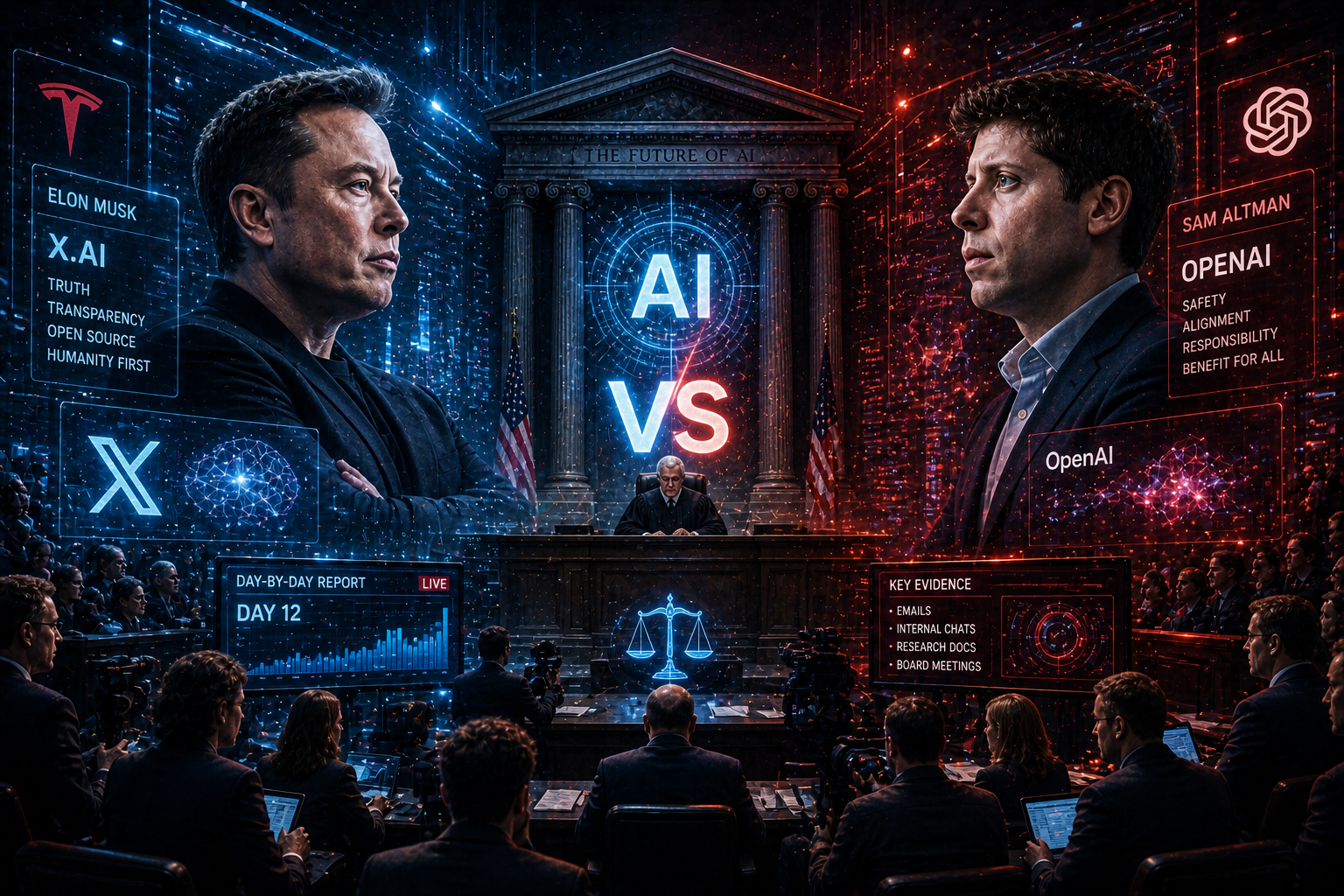
He donated $38 million. They built an $800 billion company. He called himself
“a fool.” They said he “didn’t get his way and quit.” Now Elon Musk and Sam Altman
are in a federal courtroom — and the verdict could reshape artificial intelligence forever.
The Origin Story: How OpenAI Began — and How It Fell Apart
The story of OpenAI is, at its core, a story about a big idea, an enormous bet, and a friendship that curdled into one of the most consequential feuds in the history of technology. It begins in 2015, at the dinner tables and backrooms of Silicon Valley, where a small group of technologists had become convinced that artificial intelligence was the most important thing humanity would ever build — and that it was developing in exactly the wrong hands.
That group included Elon Musk, who was already the most famous entrepreneur in the world; Sam Altman, then president of Y Combinator and one of Silicon Valley’s most respected operators; Greg Brockman, a brilliant engineer; Ilya Sutskever, one of the world’s foremost AI researchers; and Shivon Zilis, a venture capitalist who would become, over the following years, one of the most significant and most quietly controversial figures in the entire OpenAI saga.
Their shared worry: Google and its DeepMind division were consuming the world’s best AI talent, pointing it at commercial products, and operating in closed labs beyond public scrutiny. The group believed that if artificial general intelligence — AI matching or exceeding human intelligence — was going to be developed, it needed to be developed in public, with its research freely shared, governed by people who prioritized human benefit over shareholder returns.
ELON MUSK Testimony, Day 1, April 28, 2026
And so in December 2015, OpenAI was born — as a nonprofit, with Musk and Altman as co-chairs, and a founding charter that committed to developing AI “for the long-term benefit of humanity.” Musk pledged up to $1 billion in donations. He ultimately contributed $38 million before leaving the board in 2018. What happened between that founding moment and the Oakland courtroom in 2026 is the subject of the most important technology lawsuit in history.
The Lawsuit: What Musk Is Actually Claiming
Musk’s lawsuit, filed in 2024 and finally reaching trial in April 2026, makes three core claims that his legal team must prove to a jury:
Breach of Charitable Trust
Musk gave donations to OpenAI as a nonprofit with a specific charitable mission. By converting to a for-profit structure — creating a for-profit subsidiary, accepting Microsoft’s billions, and now being valued at $800 billion — OpenAI violated the terms under which those donations were made. Musk argues this constitutes misappropriation of charitable assets.
Core legal claim
Fraud and Misrepresentation
Musk claims Altman and Brockman repeatedly assured him that OpenAI would remain open-source and not-for-profit. He has introduced text messages in which Altman allegedly told him the product would remain “open and available to all.” He argues these representations were fraudulent inducements that convinced him to continue funding the organization.
Text message evidence
Breach of Contract
Musk argues the founding charter constituted a binding contractual commitment to a nonprofit structure. By abandoning that structure, Altman, Brockman, and OpenAI breached specific commitments — and Microsoft aided and abetted this breach through its $13 billion-plus investment in the for-profit subsidiary.
Microsoft named as defendant
What Musk Wants
Musk seeks three outcomes: (1) reversal of the for-profit conversion, (2) removal of Sam Altman and Greg Brockman from leadership, and (3) financial damages. The remedies phase will only occur if the jury finds in Musk’s favor on the liability claims.
Two-phase trial
What makes this case unusual: Most corporate lawsuits are about money. This one is also about power and principle — specifically, who gets to control one of the most consequential technologies in human history. Even if Musk wins every legal argument, a court ordering the reversal of OpenAI’s corporate structure would be an intervention in private commerce with almost no modern precedent. Legal scholars say the case is, at its heart, an argument about whether the promises made at the founding of an organization have any binding force in the age of trillion-dollar AI.
The Key Players: Everyone in the Courtroom
Elon Musk
Co-founder of OpenAI. Donated $38M. Left the board in 2018. Now runs xAI — OpenAI’s most direct competitor. Is suing his former collaborators.
Sam Altman
The man Musk is trying to remove. Watched Musk testify from across the courtroom. Did not return to the courtroom for parts of Musk’s testimony. Will testify himself.
Greg Brockman
The second person Musk is seeking to remove. Was present in the courtroom during Musk’s testimony. Called “Greg Stockman” by Musk on social media during jury selection.
Shivon Zilis
Former OpenAI board member. Currently lives with Musk. Mother of four of his children. Works at Neuralink. Has emails that both sides claim support their version of events. Expected to testify.
Satya Nadella
Microsoft is named as a defendant for allegedly aiding and abetting the charitable trust breach through $13B+ in investments. Nadella is expected to testify.
Judge Yvonne Gonzalez Rogers
Overseeing the trial. Already told Musk to reduce social media activity after he posted mocking comments about Altman during jury selection. Described managing Musk’s answers as “the challenge of all litigants.”
Day 1 — April 28: Musk Takes the Stand
Musk Sworn In — “I Came Up with the Idea, the Name, Everything”
The day began with jury selection — during which Musk posted mocking comments on X targeting Sam Altman as “Scam Altman” and Greg Brockman as “Greg Stockman.” Judge Gonzalez Rogers responded within hours, requesting both Musk and Altman minimize their social media activity. Musk agreed.
When Musk took the witness stand for opening testimony, the courtroom filled with a tension that CNBC reporters described as palpable. Musk’s attorney, Stephen Molo, walked him through OpenAI’s founding — establishing, with Musk’s help, that the organization was born as a nonprofit with explicit commitments to the public good.
Musk introduced the founding charter from 2015 as evidence — displayed on a courtroom monitor — which declared that OpenAI would seek to create “open source technology for the public benefit” and was “not organized for the private gain of any person.” Musk described his understanding clearly: “It was specifically meant to be for a charity that did not benefit any individual person.”
Musk’s tone was controlled but passionate. He spoke about his fear that Google’s DeepMind was developing AGI without public accountability, and his belief that a nonprofit OpenAI was the necessary counterweight. He testified that he would not have contributed his resources — money, reputation, and time — if he believed the founders intended to profit from the organization.
ELON MUSK Direct examination, Day 1 · April 28, 2026
The strategic opening move: Musk’s lawyers used Day 1 to establish a simple, emotionally resonant narrative: a man gave his money to build something good for humanity, and the people he trusted took that money and built a private empire. Whether or not it’s legally precise, it’s a story a jury can understand. OpenAI’s counter-narrative — that Musk wanted control all along — is more complex to tell. Which story wins in the courtroom may determine which side wins the case.
Day 2 — April 29: The Haunted Mansion, the “Robot Army,” and $38M vs. $800B
“I Was a Fool” — Musk Grows Combative Under Cross-Examination
Day 2 was where the trial became a spectacle. OpenAI’s lead attorney, William Savitt, began cross-examining Musk — and within an hour, the tone in the courtroom had transformed from measured legal proceedings to something closer to an intellectual cage match.
Savitt probed a 2017 video game tournament — a Defense of the Ancients competition won by an AI bot — which had reportedly galvanized Musk’s view that OpenAI was at risk of falling behind Google. He asked Musk about a subsequent meeting with Altman, Brockman, Zilis, and others that happened after a San Francisco wedding Musk attended. “And then there was a meeting at the haunted mansion?” Savitt asked. Musk confirmed the meeting took place but could not recall whether Zilis had taken notes — or whether he had urged those present to pivot to a for-profit structure.
The most dramatic moment came when Savitt pressed Musk on the gap between his $1 billion pledge and his actual $38 million in contributions. “Without me, OpenAI wouldn’t exist!” Musk said, raising his voice. He argued that beyond money, he contributed his reputation and relationships — things with value that couldn’t be easily quantified on a balance sheet.
Then came the line that defined the day: “I actually was a fool who created free funding for them to create a startup. I literally was.” And later: “I gave them $38 million of essentially free funding which they then used to create an $800 billion for-profit company.” Both lines were delivered with a combination of anger and self-awareness that reportedly left the jury visibly attentive.
ELON MUSK Cross-examination, Day 2 · April 29, 2026
ELON MUSK Jury testimony, Day 2 · April 29, 2026
The exchange about Microsoft’s investment of $10 billion was particularly revealing. Musk testified that when he learned about the deal, he “reacted quite negatively” and texted Altman something like “What the hell is going on?” He said the scale of Microsoft’s involvement — and the implied expected return — convinced him that OpenAI had ceased to function as a charity. “With all due respect to Microsoft, do you really want Microsoft controlling artificial general intelligence?” Musk told the jury.
Throughout Day 2, Judge Gonzalez Rogers repeatedly intervened, urging Musk to answer simple questions directly. When Savitt pointed out to the judge that he was having difficulty getting direct answers, Rogers responded with dry humor: “That is the challenge of all litigants.”
Day 3 — April 30: Shivon Zilis, the Secret Emails, and Social Media Chaos
The Zilis Emails — OpenAI’s Most Explosive Evidence
If Day 2 was the most dramatic, Day 3 was the most consequential for the legal outcome. Savitt returned to the subject of Shivon Zilis — and introduced a series of emails that OpenAI’s lawyers argued fundamentally undermined Musk’s central claim: that he never knew about, or consented to, discussions about converting OpenAI into a for-profit entity.
Savitt showed the jury an email from Zilis — then on the OpenAI board, simultaneously a friend of Musk’s, and mother of four of his children — to Sam Teller, who worked directly for Musk. The email described two potential ways OpenAI could change its structure: “Roll everything into a B corp” or “OpenAI C Corp and OpenAI non-profit.” OpenAI’s lawyers argued this email, which passed through Musk’s own office via Teller, proved that Musk had been informed of the for-profit conversion planning from the beginning — and that his current claim of betrayal was manufactured.
Savitt put the accusation directly: “Musk supported a for-profit entity as long as he retained control.” He also argued that Musk’s $38M contribution fell dramatically short of his “$1 billion” pledge, forcing OpenAI to seek other funding — including from Microsoft — because Musk didn’t deliver what he promised.
Musk pushed back on every point but visibly struggled with the email evidence. He said he did not recall whether Zilis had shared the email content with him. He said he could not confirm he had “instructed Zilis to file paperwork” to convert OpenAI to a for-profit structure — the specific action Savitt alleged. Asked about Zilis’s role, Musk’s testimony evolved over the day: on Tuesday he described her as “my chief of staff, uh, yeah.” By Wednesday he had clarified her title was actually “senior adviser” — and that “we live together” and “she’s the mother of four of my children.”
WILLIAM SAVITT OpenAI Attorney · Cross-examination, April 30, 2026
The Evidence: The Documents That Matter Most
Both sides have introduced documents that they claim are decisive. Here are the most significant pieces of evidence and what each side says they prove:
The 2015 Founding Charter
OpenAI’s original founding document, displayed on the courtroom monitor during Musk’s testimony. Declares OpenAI would create “open source technology for the public benefit” and was “not organized for the private gain of any person.” Musk’s core exhibit. OpenAI argues it was always understood to be a mission statement, not a binding legal contract.
Musk’s strongest document
The Zilis Email to Sam Teller
Email from Shivon Zilis (OpenAI board, mother of Musk’s children) to Sam Teller (Musk’s employee) describing plans to restructure OpenAI as either a B Corp or a C Corp + nonprofit hybrid. OpenAI argues this proves Musk knew about for-profit planning early. Musk says he doesn’t recall receiving or acting on this information.
OpenAI’s strongest document
Musk’s “Initial Control” Email
An email Musk sent during early for-profit discussions in which he stated he felt entitled to “initial control” and the largest portion of shares. OpenAI argues this proves Musk’s objection to the for-profit structure was about control, not principle. Musk argues this email predates, and is different from, the actual conversion he’s challenging.
Complicates Musk’s claim
Altman’s Text to Musk
Musk introduced a text message from Sam Altman in which Altman allegedly assured him the product would remain “open and available to all.” Musk argues this was a fraudulent representation. OpenAI argues the context was about product availability, not corporate structure, and does not constitute a legally binding commitment.
Disputed interpretation
The Microsoft Investment Evidence
Documentation of Microsoft’s $10 billion (later $13B+) investment in OpenAI’s for-profit subsidiary. Musk argues the scale of this investment proves OpenAI ceased to function as a charity. Microsoft’s lawyers counter that the investment came after Musk left the board and that he knew of the Microsoft relationship since at least 2020, per a Musk X post.
Microsoft’s defense
Musk’s 2020 X Post
A September 2020 post from Musk on X stating that “OpenAI is essentially captured by Microsoft.” Microsoft’s lawyers introduced this to argue Musk had been aware of the Microsoft relationship years before filing his 2024 lawsuit — potentially exceeding the statute of limitations for his claims.
Statute of limitations risk
The Shivon Zilis Factor: The Most Complicated Witness in Tech History
In any other trial, the key witness might be a CFO, a board member, or a whistleblower. In this trial, the most consequential potential witness is a woman who shares four children with the plaintiff, has worked at companies he controls, and sent emails to his employees while serving on the board of the defendant organization. Shivon Zilis may be the most complicated witness in the history of technology litigation.
Here is what we know for certain about Zilis’s role: She was a venture capitalist who joined OpenAI’s board. She sent emails discussing potential corporate restructuring to an employee of Elon Musk. She now works at Neuralink — one of Musk’s companies. She lives with Musk. She is the mother of four of his children. And she may be called to testify in a trial where both sides believe her testimony supports their version of events.
ELON MUSK On Shivon Zilis · Cross-examination, Day 2 · April 29, 2026
OpenAI’s lawyers want the jury to understand Zilis as a conduit between Musk and OpenAI’s leadership — someone whose emails prove Musk was kept fully informed about the for-profit discussions and, crucially, did not object to them as long as he was in control. Musk’s lawyers want the jury to understand Zilis as an OpenAI insider whose emails reflect her own communications, not instructions or knowledge that Musk acted upon.
The truth is almost certainly somewhere in the complicated middle of a personal and professional relationship that is genuinely unlike anything a court has previously been asked to parse. The emails exist. The relationship exists. What the jury makes of both will be central to its verdict.
The legal significance of Zilis’s emails: If OpenAI can convincingly show that emails discussing for-profit conversion passed through Musk’s own staff from Zilis while she was on the board — and that Musk took no action to stop it or express objection — it significantly undermines his claim that the conversion was a surprise betrayal. Instead, it suggests he knew, and his real objection was to losing control of the process, not the process itself.
OpenAI’s Defense: “He Wanted Control — Not Purity”
OpenAI’s defense strategy, articulated by attorney William Savitt in his opening statement and cross-examination, rests on a single devastating argument: Musk’s objection to OpenAI’s for-profit structure was never really about protecting a charitable mission. It was about protecting his own control over the organization — and when he lost that control, he left, and is now trying to use the courts to get it back.
WILLIAM SAVITT OpenAI Attorney · Opening Statement, Day 1
The evidence OpenAI has introduced to support this narrative is substantial. Emails from the early for-profit discussions show Musk explicitly seeking “initial control” and the majority of the capitalization table. The Zilis emails show that restructuring plans — specifically, the hybrid nonprofit/C-Corp model — were discussed with people in Musk’s direct orbit. And Musk’s own 2020 X post shows he publicly acknowledged Microsoft’s relationship with OpenAI three years before filing his lawsuit.
OpenAI also targets the statute of limitations directly. If Musk knew about the Microsoft relationship — and his own post suggests he did — then his 2024 lawsuit may have been filed too late under California law. Microsoft’s lawyers pressed this point in their opening statement, noting the September 2020 post as evidence that Musk’s claims had already expired before he filed them.
OpenAI’s strongest counter-argument: Savitt’s argument that “Musk never expressed the view that OpenAI had to remain purely nonprofit” — supported by the Zilis emails — is potentially more legally damaging to Musk’s case than the financial arguments. If the jury believes Musk was aware of and implicitly supported the for-profit discussions, the breach of trust claim loses its foundation. The trial may ultimately be decided by how the jury reads those emails.
Microsoft’s Role: $13 Billion and a Seat at the Defense Table
Microsoft’s presence in this trial is significant and, for a company whose CEO Satya Nadella is scheduled to testify, uncomfortable. Musk accuses Microsoft of aiding and abetting OpenAI’s alleged breach of charitable trust through its investments — effectively arguing that Microsoft’s money enabled the abandonment of OpenAI’s nonprofit mission.
Microsoft’s defense lawyer, Russell Cohen, offered a straightforward counter in his opening statement: Microsoft did not and could not have aided a breach it didn’t know was occurring. Cohen also pointed to the statute of limitations argument, noting that Musk’s own 2020 X post — in which he described OpenAI as “essentially captured by Microsoft” — suggested Musk had knowledge of the relationship years before filing suit.
ELON MUSK Post on X (then Twitter) · September 2020 — Used as evidence against him in trial
Separately, the week of the trial also saw Microsoft and OpenAI announce a revamped version of their partnership — with the explicit dissolution of their exclusivity agreement. The timing was awkward for both companies but legally was presented as business-as-usual evolution of a partnership. Microsoft’s investment in OpenAI, in its original form, exceeded $13 billion across multiple tranches since 2019.
The Microsoft paradox: Microsoft is simultaneously OpenAI’s largest institutional investor AND one of its biggest competitors — now that Microsoft has integrated OpenAI’s technology into its own products while also adding xAI’s Grok models to Azure. The trial has exposed the tangled web of relationships at the top of the AI industry in ways that even industry analysts hadn’t fully mapped. Satya Nadella’s testimony, when it comes, will be one of the most-watched events of 2026.
The Complete Timeline: From 2015 to the Courtroom
OpenAI Founded as a Nonprofit
Musk, Altman, Brockman, Sutskever, Zilis, and others co-found OpenAI. Charter declares it will create “open source technology for the public benefit.” Musk pledges up to $1 billion. His actual contributions total $38 million.
The Defense of the Ancients Moment
An AI bot wins a major video game tournament, alarming Musk about the competitive pace of AI development. A meeting follows at “the haunted mansion” to discuss OpenAI’s future — including, allegedly, its corporate structure. Musk says he doesn’t recall urging a for-profit pivot. Zilis may have taken notes.
Musk Leaves the Board
After a reported disagreement about who would run the for-profit subsidiary being discussed, Musk resigns from the board. He says he was frozen out. OpenAI says he wanted majority control and couldn’t accept the answer “no.”
OpenAI Creates For-Profit Subsidiary
OpenAI establishes a “capped-profit” for-profit subsidiary — allowing investors to make money but limiting returns to 100x. Microsoft makes its first investment. The nonprofit structure begins its transformation.
Musk Posts “Captured by Microsoft”
Musk publicly posts on X that “OpenAI is essentially captured by Microsoft.” Microsoft’s lawyers say this proves Musk knew about the relationship in 2020 — potentially blowing his statute of limitations. Musk’s lawyers dispute the interpretation.
ChatGPT Changes Everything
ChatGPT launches. 100 million users in 60 days. OpenAI becomes a household name. Its valuation begins a trajectory that reaches $800 billion+. Musk founds his own AI company, xAI, the following year.
Musk Files Lawsuit
Musk files the original lawsuit against OpenAI, Altman, and Brockman, claiming breach of charitable trust, fraud, and breach of contract. The case generates global headlines and begins two years of legal maneuvering.
Trial Begins in Oakland
Musk takes the witness stand. The trial attracts global media coverage. Jury selection is complicated by Musk’s social media posts. The judge asks both sides to minimize their online activity. The most consequential tech trial in history is underway.
Verdict and Remedies — TBD
The trial is expected to proceed through May with multiple witnesses including Altman, Nadella, and potentially Zilis. A verdict in Phase 1 (liability) will be followed by Phase 2 (remedies) if Musk prevails. The outcome could reshape OpenAI, the AI industry, and the legal definition of what a charitable promise means in the age of trillion-dollar technology.
What’s at Stake: The AI Power Map If Musk Wins or Loses
The verdict will have consequences far beyond the parties in the courtroom. Here is the realistic impact of each outcome:
If Musk Wins — Liability Phase
A judgment finding OpenAI breached its charitable trust would be legally unprecedented. It would trigger a remedies phase where Musk could seek reversal of the for-profit structure, removal of Altman, or financial compensation. Any of these outcomes would send shockwaves through every AI company that has accepted investor money with a mission statement.
If Musk Wins — Structural Reversal
The most dramatic remedy would be forcing OpenAI to reverse its for-profit conversion. This would effectively unwind $13B+ in Microsoft investments, reprice OpenAI’s $800B valuation, and create a governance crisis at the most influential AI company in the world. Most legal scholars consider this outcome extremely unlikely — but not impossible.
If Altman Wins — OpenAI Validated
A clear OpenAI victory validates the for-profit conversion, eliminates the legal uncertainty that has shadowed every major OpenAI deal, and frees the company to accelerate its IPO timeline. It also signals to every other AI company that mission-statement commitments made before funding rounds are not legally enforceable contracts.
If Musk Loses — xAI Benefits
A loss strengthens Altman’s position at the most powerful AI company on Earth — and leaves Musk building xAI from second place. Musk has invested enormous personal capital, time, and reputational risk in this lawsuit. A clear loss would be a significant setback at exactly the moment he is trying to establish xAI’s Grok as a legitimate ChatGPT rival.
Broader Legal Precedent
Regardless of the verdict, this trial is setting legal precedent for what “nonprofit mission commitment” means in the technology sector. Every AI lab, every tech nonprofit, and every venture firm investing in mission-driven organizations is watching this case — because the verdict will define their legal exposure for decades.
Global AI Governance
Musk’s central argument — that AI development needs accountability structures that survive financial success — echoes the concerns of regulators in the EU, UK, and beyond. A Musk win would empower those who argue AI companies must be held to their founding commitments. A Musk loss would embolden those who argue market forces, not mission statements, should govern AI development.
The Judge, the Jury, and What Happens Next
Judge Yvonne Gonzalez Rogers of the U.S. District Court for the Northern District of California has presided over the case with evident control of an exceptionally difficult room. She has managed Musk’s combativeness with dry humor and judicial firmness, intervening during cross-examination to urge direct answers and handling the social media situation with measured authority.
The trial proceeds in two phases. Phase 1 — currently underway — asks the jury to determine whether the defendants are liable for the claims Musk has made. Phase 2, which would only occur if Musk prevails in Phase 1, would determine the specific remedies. Additional witnesses expected to testify include Sam Altman, Satya Nadella, and potentially Shivon Zilis.
Expected timeline: Phase 1 is expected to conclude by late May 2026. If Phase 2 is required, proceedings could extend into July or August. An appeal, regardless of outcome, is virtually certain given the unprecedented nature of the legal questions. Final resolution — including all appeals — could be years away. In the meantime, OpenAI continues to operate, raise money, and release models. The company’s legal uncertainty has not meaningfully slowed its commercial momentum.
This trial is, at its most fundamental level, a story about what happens when the promises we make before we understand the stakes meet the reality of what we built. Musk promised money he didn’t fully deliver. Altman promised openness he didn’t fully maintain. And somewhere in the gap between those two failures, an $800 billion company was born — and a federal jury in Oakland, California, is now being asked to decide who was right.
FAQ: Everything About the Musk vs. Altman Trial
📚 Primary Sources — All Directly Reported
- CNBC — OpenAI Lawsuit Updates: Elon Musk v. Sam Altman Trial Day 3 — Live courtroom coverage, April 29, 2026
- CNBC — OpenAI Trial Day 2: Musk Gets Testy Under Cross-Examination
- CNN Business — Takeaways from Day 1 of the Elon Musk and Sam Altman Trial
- NPR — Elon Musk Accuses OpenAI’s Leaders of ‘Looting the Nonprofit’ in Court Testimony
- SF Standard — Musk Gets Testy on the Stand in Day 2 of OpenAI Trial
- Seoul Economic Daily — Judge Tells Musk to Curb Social Media Use in OpenAI Trial
⚖️ Follow the Trial — Updated Daily
This is the most consequential technology trial in history. Subscribe free to receive our daily courtroom briefing — key testimony, evidence updates, and what it means for the AI industry — every morning.